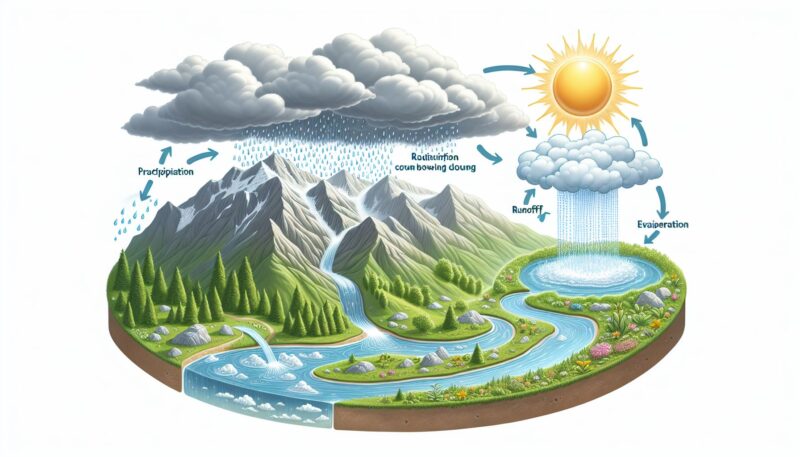
Water is the lifeblood of our planet, a fundamental resource that sustains all forms of life, shapes our ecosystems, and drives our climate. Yet, the complexity of how water moves through the Earth’s system – the process known as the hydrologic cycle – often remains overlooked. In this comprehensive exploration, we will dive deep into the fascinating mechanisms of the hydrologic cycle and understand why it is crucial for life as we know it.
What is the Hydrologic Cycle?
At its core, the hydrologic cycle is a continuous and dynamic system that describes the movement, distribution, and quality of water on, above, and below the Earth’s surface. This cycle plays a pivotal role in shaping weather patterns, supporting biodiversity, and maintaining ecosystems. Let’s break down the key processes that make up this intricate cycle:
Evaporation
Evaporation is the transformation of water from its liquid state to a gaseous state, known as water vapor. This occurs when energy, usually from the sun’s heat, provides enough power to break the molecular bonds holding water molecules together. Evaporation predominantly takes place over the vast surface of the oceans but also occurs in freshwater bodies and from moist soil. Plants further contribute through a process known as transpiration.
Transpiration
Transpiration is the process by which water absorbed by plant roots is evaporated into the atmosphere from the plant leaves and stems. Alongside evaporation, transpiration is a key component of what is termed ‘evapotranspiration,’ representing the combined water loss to the atmosphere from all land sources.
Condensation
As water vapor rises into the atmosphere, it cools down and eventually condenses back into liquid water droplets. These droplets cluster around dust particles forming clouds. Condensation is the inverse of evaporation and a precursor to precipitation.
Precipitation
Precipitation occurs when the water droplets in clouds become heavy enough to overcome air resistance and fall to the Earth’s surface. It comes in various forms: rain, snow, sleet, or hail, and is the primary means through which water returns from the atmosphere to Earth’s surface.
Infiltration
When water reaches the ground, it doesn’t simply rest on the surface; some of it soaks into the soil, a process known as infiltration. The rate of infiltration depends on various factors, including soil type, vegetation cover, and saturation levels.
Percolation
Percolation is the downward movement of water within the soil layers, often reaching the groundwater reservoirs. This process is integral to recharging aquifers – the underground layers of water-bearing permeable rocks or materials.
Runoff
Runoff occurs when the soil is saturated and can’t absorb more water, causing the excess to flow over the surface. This water travels over the land and channels into streams, rivers, lakes, and eventually back to the oceans, becoming part of what is known as streamflow or river flow.
Baseflow
Baseflow refers to the portion of a river’s flow that is sustained between periods of precipitation. This flow comes from groundwater seeping into the riverbed, which is crucial for maintaining river ecosystems during dry periods.
Groundwater Movement
Subsurface water doesn’t remain static; it can slowly flow through the soil and rock layers, often emerging as springs or seeps. Groundwater movement is influenced by gravity and the pressure gradient within the aquifer systems.
The Importance of the Hydrologic Cycle
Understanding the hydrologic cycle isn’t just an academic endeavor—it has profound implications for our everyday life, our economies, and the planet’s health. Here are some of the reasons why:
- Climate Regulation: The exchange of energy during evaporation and condensation significantly influences the Earth’s climate patterns.
- Agriculture: A predictable precipitation and runoff cycle is crucial for agriculture, as it ensures the availability of water for crops.
- Drinking Water: The cycle is responsible for replenishing freshwater sources that provide us with the water we need for survival.
- Ecosystems: Many ecosystems are intricately linked with specific aspects of the hydrologic cycle, with some creatures entirely dependent on the timing of flow events.
Human Impact and Modifications
Humans have greatly affected the natural hydrologic cycle primarily through the construction of dams and reservoirs, the expansion of irrigation, deforestation, urbanization, and pollution. These activities can disrupt the delicate balance of the natural cycle, leading to issues like habitat destruction, water scarcity, and water quality degradation.
Conclusion
The hydrologic cycle is, without a doubt, one of the most critical systems on our planet. It connects oceans, land, and atmosphere, it supports life in countless ways, and it maintains the natural balance of our ecosystems. While it may seem like an autonomous, self-sustaining process, human actions can and have had significant impacts on this cycle. It is, therefore, our responsibility to understand and protect this complex, life-sustaining system.
Sources
To further explore the intricacies of the hydrologic cycle and its relevance, consider reviewing these resources:
-
United States Geological Survey (USGS). The Water Cycle.
[https://www.usgs.gov/special-topics/water-science-school/science/water-cycle-overview](https://www.usgs.gov/special-topics/water-science-school/science/water-cycle-overview) -
National Oceanic and Atmospheric Administration (NOAA). The Water Cycle.
[https://www.noaa.gov/education/resource-collections/freshwater/water-cycle](https://www.noaa.gov/education/resource-collections/freshwater/water-cycle) -
The Nature Conservancy. The Role of Natural Infrastructure in the Water Cycle.
[https://www.nature.org/en-us/what-we-do/our-priorities/provide-food-and-water-sustainably/food-and-water-stories/natural-infrastructure-water-cycle/](https://www.nature.org/en-us/what-we-do/our-priorities/provide-food-and-water-sustainably/food-and-water-stories/natural-infrastructure-water-cycle/)