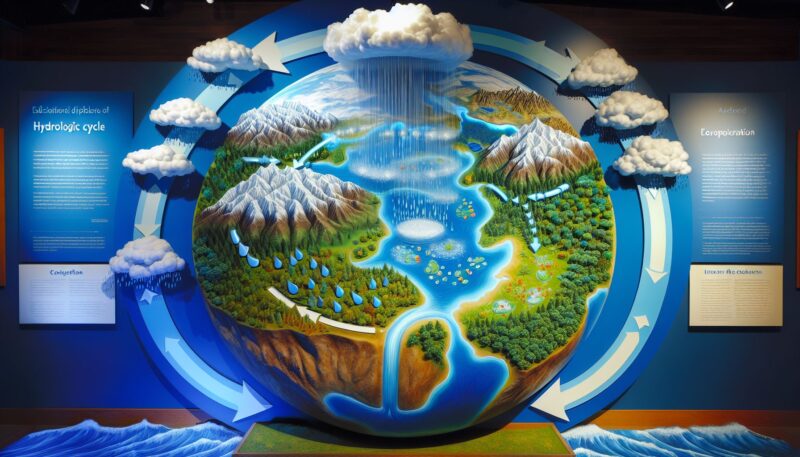
Water is the elixir of life. It shapes our world in countless ways, most of which we hardly ever pause to think about. The journey of a single drop of water might start and end in the vast expanse of the ocean. But as it travels through Earth’s diverse systems, it unveils the marvels of the hydrologic cycle. The hydrologic cycle, often referred to as the water cycle, is a fundamental process sustaining life on our planet. It involves various phases including evaporation, transpiration, condensation, precipitation, infiltration, percolation, and runoff. This cycle does more than just quench our thirst; it affects climate patterns, shapes landscapes, and maintains ecosystems.
Phases of the Hydrologic Cycle
The hydrologic cycle is a continuous process that can be observed everywhere: from the tiny water droplets on leaves to the grandeur of ocean currents. To appreciate its complexity and grand scale, let’s take a closer look at the individual processes.
Evaporation
Evaporation is the transformation of water from a liquid to a gas. Sunlight heats the water in oceans, rivers, lakes, and even moist soil, allowing molecules to escape into the air as water vapor. It is a crucial first step, accounting for 86% of global evaporation occurring from the oceans.^[1]^
Transpiration
Closely linked to evaporation is transpiration – where water within plants evaporates into the atmosphere from the surface of leaves, stems, and flowers. This less visible but significant phase is often combined with evaporation and termed “evapotranspiration.”
Condensation
As water vapor rises, it cools and condenses into tiny droplets, forming clouds. Condensation is the process responsible for this phase change from a gas back to a liquid, which prepares the water to return to the earth’s surface.
Precipitation
When the droplets in clouds combine to become heavier, they fall to Earth due to gravity, in forms ranging from rain and snow to sleet or hail – a process known as precipitation.
Infiltration and Percolation
As precipitation reaches the land, some of it infiltrates the soil, seeping down through the earth’s layers in a process known as percolation, becoming part of the groundwater system.
Runoff and Streamflow
Not all water is absorbed by the soil; some flows across the surface, a process known as runoff. Runoff contributes to streamflow, which feeds into rivers and lakes, and eventually returns to the oceans.
Groundwater and Baseflow
Part of the infiltrated water becomes groundwater, which travels through aquifers – rock formations capable of storing and transmitting water. Eventually, this groundwater contributes to baseflow, which sustains river flow during periods without rainfall.
Interaction with the Oceans
The seas are where our hydrologic cycle stories often start and end. Oceans store major volumes of the Earth’s surface water and act as the primary source of evaporation, while also receiving water from rivers and precipitation.
Observing all these processes, we see a remarkable, coordinated system. However, it’s not just about water moving around. It’s about energy transfer, climate regulation, and life support.
Why the Hydrologic Cycle Matters
Beyond its climatic influence, the hydrologic cycle is intrinsically linked with critical environmental and societal issues.
Water Scarcity and Distribution
Although our planet has plenty of water, the distribution is uneven, leading to water scarcity in some regions. Less than 1% of the world’s water is fresh and accessible.^[2]^ The hydrologic cycle affects where and how this fresh water is replenished, which is why understanding it is essential for managing water resources.
Water Quality and Ecosystem Health
As water moves through the cycle, it picks up pollutants, affecting the quality and health of ecosystems. Assessing and improving water quality are constant challenges addressed by environmental management strategies and water treatment processes.
Disaster Management
Extreme weather events, such as floods and droughts, are direct outcomes of disruptions in the hydrologic cycle. Effective land and water management can mitigate their impact, saving lives, and reducing economic losses.
Climate Change Connections
Finally, the hydrologic cycle is a critical component of our planet’s climate system. As global temperatures rise, the cycle intensifies, potentially leading to more extreme weather events.^[3]^
Human Influence on the Hydrologic Cycle
Human activities have profound impacts on the hydrologic cycle. Land development changes the landscape, often reducing infiltration and increasing runoff, which can lead to flash flooding. Agriculture, industry, and urbanization contaminate water sources with pollutants like nutrients, pathogens, and heavy metals, disrupting the natural filtration processes within the cycle.
Water Management Strategies
To counterbalance our impact on the hydrologic cycle, we turn to water management strategies. This is where concepts like recharge, discharge, and controlled use of aquifers come in.
Recharge
Recharge refers to the process of adding water back to an aquifer, typically through rainfall or artificially, via methods like recharge basins or injection wells.
Discharge
Discharge is the natural or artificial removal of water from an aquifer. It includes water flowing from springs, pumped for human use, or transferred through tree roots in transpiration.
Strategic recharge and discharge management is crucial for sustainable water use, ensuring that aquifers are not depleted.
Tools and Technologies for Water Stewardship
Amid growing concerns about water resources, technologies for monitoring and managing the water cycle are crucial. Innovations include satellite-based remote sensing for monitoring snowpack and glaciers, advanced treatment processes for maintaining water quality, and smart meters and sensors aiding in leak detection and water conservation.
Water Treatment
Treatment technologies like coagulation, flocculation, filtration, and disinfection ensure safe drinking water by removing contaminants. Advanced treatments, such as ozonation, UV irradiation, and reverse osmosis, are employed for more challenging impurities, including microplastics and dissolved organics.
Water Conservation
Conservation efforts often focus on reducing usage and waste. Techniques like rainwater harvesting, greywater reuse, and efficient irrigation systems support this effort, lessening the demand on conventional water sources and reducing the burden on the hydrologic cycle.
Conclusion
Understanding the hydrologic cycle is not just an academic pursuit; it’s a fundamental aspect of coping with the environmental challenges of the 21st century. As we confront issues like water scarcity, pollution, and climate change, our grasp on this complex system will determine how we safeguard our most precious resources.
It is our collective responsibility to steward the cycle effectively, ensuring clean, ample water for ecosystems, communities, and future generations. Only through informed management, innovative technology, and global cooperation can we maintain the balance of Earth’s lifeline – the wondrous and all-encompassing hydrologic cycle.
^[1]^ “The Water Cycle.” United States Geological Survey (USGS). https://www.usgs.gov/special-topic/water-science-school/science/water-cycle
^[2]^ “The World’s Water.” Pacific Institute. http://www.worldwater.org/
^[3]^ Trenberth, K. E., et al. “Changes in precipitation with climate