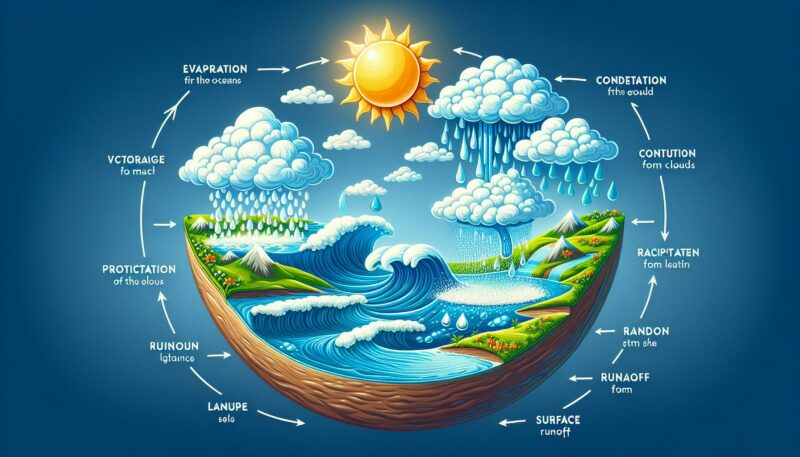
Water is life, a stark reality that underpins the importance of the hydrologic cycle to our planet’s health and sustenance. The hydrologic cycle, also known as the water cycle, is a continuous process by which water circulates throughout the Earth’s hydrosphere, involving the atmosphere, land, and the oceans. It is a critical ecological cycle that impacts everything from global weather patterns to the availability of fresh water for human consumption. This article delves into the intricate process of the hydrologic cycle and its crucial role in regulating the Earth’s environment.
What is the Hydrologic Cycle?
The hydrologic cycle is the natural process that distributes and recycles Earth’s water supply. It is a dynamic system consisting of various stages such as evaporation, transpiration, condensation, precipitation, infiltration, percolation, runoff, and storage in bodies of water like rivers, lakes, and oceans.
Evaporation and Transpiration
Evaporation is the process where water is converted from liquid to vapor form and rises into the atmosphere. This process is primarily powered by the sun’s energy. Transpiration, on the other hand, is similar to evaporation, but it occurs in plants. As plants absorb water from the soil, they release water vapor from their leaves into the atmosphere. Together, evaporation and transpiration account for the significant movement of water into the air, a process collectively known as “evapotranspiration.”
Condensation and Precipitation
Condensation is when water vapor in the atmosphere cools and changes into liquid droplets, forming clouds. When these droplets combine and grow heavy enough, they fall to Earth’s surface as precipitation. Precipitation comes in various forms including rain, snow, sleet, and hail, depending on the temperature and atmospheric conditions.
Infiltration, Percolation, and Runoff
Once precipitation reaches the Earth’s surface, it participates in several pathways. Infiltration is the process of water seeping into the soil. Some of this water will continue to move deeper through the soil in a process called percolation, eventually replenishing aquifers — underground layers of water-bearing permeable rock or sediments.
Water that does not infiltrate the ground becomes surface runoff, flowing into streams, rivers, and lakes. The amount of runoff is influenced by many factors, including the rate of precipitation, ground saturation, topography, and the presence of vegetation.
Streamflow and Baseflow
Streamflow is the movement of water within a river or stream, driven by runoff and precipitation. Part of streamflow is maintained by baseflow, which is the sustained flow of a stream in the absence of direct runoff. This occurs as groundwater seeps into the riverbed, providing a constant contribution to the water in the stream, particularly during dry periods.
Groundwater and Aquifer Dynamics
Groundwater is a hidden resource that resides beneath the Earth’s surface within the pore spaces of soils and geological formations. Aquifers are the geological layers that contain sufficient permeability to store and transmit groundwater. The natural process of groundwater recharge replenishes these aquifers, typically through percolation from the surface. Discharge, on the other hand, is the flow of groundwater back into the environment, often into rivers, lakes, or the ocean.
The Importance of Water Quality in the Hydrologic Cycle
The hydrologic cycle is not just about the physical movement of water but also concerns the quality of water as it travels through different phases. Water quality refers to the chemical, physical, and biological characteristics of water, which determine its suitability for various uses. Human activities, such as industrial discharges, agricultural runoff, and urban development, can introduce pollutants like heavy metals, nutrients, pathogens, and microplastics into the water cycle, leading to water pollution challenges such as eutrophication and algal blooms.
Human Impact on the Hydrologic Cycle
Human activities like deforestation, urbanization, and the emission of greenhouse gases affect the hydrologic cycle. Changes in land use can alter evaporation rates, groundwater recharge, and runoff patterns. Increased greenhouse gas emissions contribute to climate change, affecting precipitation patterns and exacerbating extreme weather events such as droughts and floods.
Water Treatment and Management
Given the impact of human activity on water quality, water treatment has become essential in ensuring safe water for consumption. Modern water treatment processes, such as filtration, disinfection (chlorination, ozonation, UV irradiation), coagulation, flocculation, sedimentation, adsorption, ion exchange, and reverse osmosis, are employed to remove contaminants and provide clean water.
Desalination technology, which removes salts and other minerals from saline water, is also pivotal in regions suffering from water scarcity, providing an alternative source of freshwater.
Conservation and Sustainable Use
Water conservation is vital to maintain water supply and quality. Measures like rainwater harvesting, greywater reuse, and reducing water footprints are ways in which individuals and communities can contribute to the sustainable use of water resources. Managing the demand for virtual water—the water embedded in products and services—is also significant in reducing the overall water consumption.
Global Water Challenges: Scarcity, Stress, and Diplomacy
As populations grow, and the demand for water increases, water scarcity becomes a pressing issue for many regions. Water stress refers to the inability to meet human and ecological demand for water. It is exacerbated by overconsumption, pollution, and climate change.
Water conflicts can arise from the competition over limited water resources. In response, water diplomacy has emerged as a field that seeks to manage shared water resources in ways that are fair, equitable, and sustainable.
Protecting our Water Future
As guardians of the Earth’s water resources, we must be cognizant of our role within the hydrologic cycle. Increased awareness leads to better practices in water management, conservation, and collaboration. Only through a concerted effort to understand and respect the delicate balance of the hydrologic cycle can we safeguard the availability of fresh water for future generations.
References
- U.S. Geological Survey. (n.d.). The Water Cycle. https://www.usgs.gov/special-topic/water-science-school/science/water-cycle
- National Oceanic and Atmospheric Administration. (n.d.). Water Cycle. https://www.noaa.gov/education/resource-collections/freshwater/water-cycle
- United Nations Water. (n.d.). Water Quality. https://www.unwater.org/water-facts/quality-and-wastewater
By gaining an understanding of the hydrologic cycle and its integral processes, we can appreciate the complex dynamics governing our planet’s freshwater resources. This deepened knowledge further emphasizes the need for responsible water use, effective regulation, and collaborative management to ensure the health of our water systems and, consequently, the life they support.