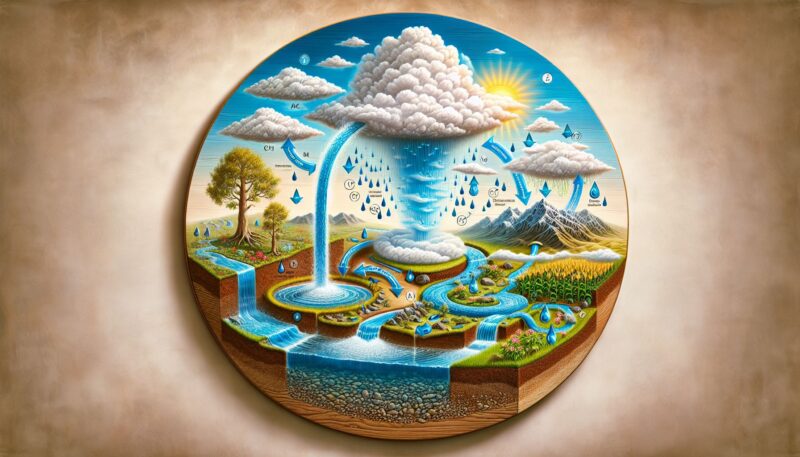
Water is essential to life on Earth, covering about 71% of our planet’s surface and constituting up to 60% of the human body. It’s a vital resource that we often take for granted, yet its journey through the environment is a complex and intricate process known as the hydrologic cycle. Understanding how this cycle works is crucial for managing our water resources, predicting weather patterns, and safeguarding ecosystems.
What is the Hydrologic Cycle?
The hydrologic cycle, also known as the water cycle, is the continuous movement of water on, above, and below the Earth’s surface. It is a system with many interconnected processes, including evaporation, transpiration, condensation, precipitation, infiltration, percolation, runoff, and more, that facilitate the distribution and recycling of the Earth’s water resources.
1. Evaporation and Transpiration
The journey of water starts with evaporation—the process by which water changes from a liquid to a gas (or vapor) form, primarily due to sun-driven energy. This occurs over oceans, lakes, rivers, and other bodies of water. In addition, plants also contribute through transpiration, wherein water absorbed by roots moves up through plants and escapes as vapor from their leaves.
2. Condensation
As water vapor rises and encounters cooler temperatures in the atmosphere, it transforms back into a liquid form—a process known as condensation. This leads to the formation of clouds, which are masses of billions of tiny water droplets or ice crystals suspended in the atmosphere.
3. Precipitation
Precipitation occurs when these water droplets or ice crystals merge to become heavy enough to fall back to the Earth due to gravity. This fall can be in the form of rain, snow, sleet, or hail.
4. Infiltration and Percolation
Upon reaching the ground, some of the water infiltrates into the soil, moving downward through the earth’s layers in a process called percolation. This water potentially recharges underground aquifers—natural reservoirs of groundwater.
5. Runoff and Streamflow
The remaining water typically flows over the land as runoff, eventually pouring into rivers, lakes, and oceans. This moving water is referred to as streamflow and is influenced by many factors, including topography, vegetation, and rainfall intensity.
6. Baseflow
Part of streamflow also comes from baseflow, which is the sustained flow of a stream derived from groundwater seeping into the bed and banks of a river or stream. This maintains river levels between rain events.
7. Groundwater and Aquifer Recharge
Below the Earth’s surface, water stored in soil or rock formations (aquifers) can act like sponges, soaking up water. This process, called recharge, replenishes the groundwater, which can be tapped into for human use via wells. Discharge is the opposite process, where groundwater enters into rivers or oceans.
The Importance of the Hydrologic Cycle
The hydrologic cycle is more than just scientific curiosity; it has profound implications:
- Climate Regulation: By transferring heat from the tropics to other parts of the world through atmospheric circulation, the water cycle plays a critical role in regulating climate.
- Life Support: Freshwater resources made available through this cycle are essential for drinking, agriculture, industry, and ecosystems.
- Environmental Indicator: Changes in the water cycle can indicate broader environmental changes, such as global warming or deforestation.
Human Impact on the Hydrologic Cycle
While the hydrologic cycle is a natural process, human activities significantly impact it. Deforestation, urbanization, and pollution can disrupt the balance of this cycle, leading to critical issues like water scarcity, pollution, and extreme weather events.
Water Conservation and Sustainability
To mitigate these problems, water conservation efforts are critical. Techniques such as rainwater harvesting, which involves collecting and storing rainwater for reuse before it reaches the ground, and greywater reuse, which reuses water from baths, sinks, and washing machines for purposes other than drinking, are important sustainability strategies. Additionally, strategies to manage water footprints and virtual water, which measure the indirect water used to produce goods and services, are important for conserving water at a larger scale.
Challenges Like Drought and Flood
Extreme weather events such as droughts and floods underscore the delicate nature of the water cycle and the need for better water management policies. Droughts reflect periods of below-average precipitation, leading to water shortages, while floods result from excessive rain or snowmelt overwhelming river systems.
Looking Ahead: Water Diplomacy and Policy
With the recognition of water’s central role in political, economic, and social structures, the concepts of water diplomacy and water conflict come to the forefront. As access to freshwater becomes increasingly strained, cooperation across political boundaries is essential. Watersheds, catchments, and drainage basins often span multiple jurisdictions, making shared management and international policies critical.
Sources:
- “The Water Cycle,” United States Geological Survey (USGS). https://www.usgs.gov/special-topics/water-science-school/science/water-cycle
- “Hydrologic Cycle,” National Oceanic and Atmospheric Administration (NOAA). https://www.noaa.gov/education/resource-collections/hydrologic-cycle-education-resources
- “Water Use and Conservation,” World Wildlife Fund (WWF). https://www.worldwildlife.org/initiatives/freshwater
Understanding the complex web of processes that make up the hydrologic cycle is crucial for protecting our precious water resources. As citizens, we can contribute by being mindful of our consumption, supporting water conservation measures, and advocating for policies that promote sustainable water management. The fate of our blue planet and the life it supports depends on it.