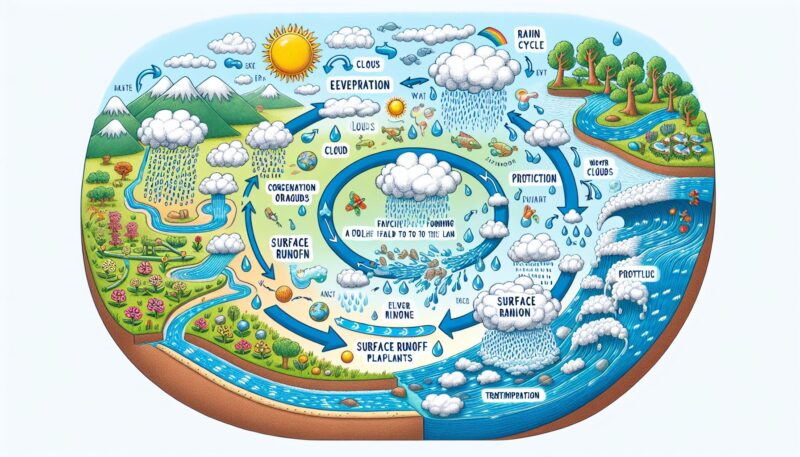
Water is the fundamental molecule that supports all forms of life on Earth. It covers about 70% of the Earth’s surface and is vital for the environment, economy, and human health. The hydrologic cycle, also known as the water cycle, is the continuous movement of water within the hydrosphere, which includes all water on, above, and below the surface of the Earth. Understanding the hydrologic cycle is essential for managing our water resources, predicting weather patterns, and sustaining life.
Understanding the Hydrologic Cycle
The hydrologic cycle is a complex system that involves various processes, such as precipitation, evaporation, transpiration, condensation, infiltration, percolation, runoff, and groundwater flow. Let’s delve into each of these processes to understand the cycle more thoroughly.
Precipitation
Precipitation is the process by which water in its liquid or solid form falls from clouds to the Earth’s surface. This includes rain, snow, sleet, and hail. Precipitation is a critical part of the hydrologic cycle, as it is the main way that water in the atmosphere is returned to the Earth’s surface.
Evaporation
Evaporation is the transformation of water from its liquid state to a gaseous state, known as water vapor. This process occurs on the surface of bodies of water such as oceans, lakes, and rivers, and also from the surface of land. The energy provided by the sun drives evaporation, making it an integral part of the water cycle.
Transpiration
Transpiration is the process by which plants absorb water from the soil and release water vapor into the atmosphere through their leaves. Together with evaporation, transpiration contributes to the overall water vapor in the atmosphere, a process collectively termed as “evapotranspiration”.
Condensation
Condensation is the process of water vapor transforming back into liquid water. This occurs when warm air rises, cools, and loses its capacity to hold water vapor, which then condenses into tiny droplets forming clouds. Condensation is an essential process for cloud formation and, eventually, precipitation.
Infiltration and Percolation
Infiltration is the process by which water on the ground surface enters the soil. Percolation refers to the movement of that water through the soil and into groundwater systems. These processes are influenced by soil composition, vegetation cover, topography, and precipitation rates.
Runoff and Streamflow
Runoff is water that flows over the land’s surface toward bodies of water like streams, rivers, lakes, or oceans. This water may originate from precipitation or melting snow or ice that doesn’t infiltrate into the ground. Streamflow is the flow of water in streams and rivers, and it is an essential component of the water cycle for transporting water across the land.
Baseflow and Groundwater
Baseflow is the portion of streamflow that comes from groundwater seeping into the river or stream bed. Groundwater is water stored in the soil and porous rock layers underground known as aquifers. It plays a key role in maintaining rivers and streams during dry periods.
Aquifers, Recharge, and Discharge
Aquifers are underground layers of water-bearing permeable rock or unconsolidated materials (gravel, sand, or silt) from which groundwater can be extracted using a water well. The process by which water soaks into an aquifer is known as “recharge”. Conversely, “discharge” is the process by which groundwater flows out of an aquifer, such as through springs or into rivers.
The Importance of the Hydrologic Cycle
The hydrologic cycle is integral to the Earth’s climate system and influences weather and climate patterns. It distributes heat across the globe via atmospheric and oceanic circulations. Moreover, it is crucial for replenishing fresh water supplies, shaping landscapes, and supporting diverse ecosystems.
Water Quality and Pollution
A key concern related to the hydrologic cycle is water quality. Pollutants can enter the water cycle through industrial discharge, agricultural runoff, or wastewater discharges, leading to environments that are toxic to humans and wildlife. Common pollutants include pathogens, nutrients, heavy metals, and microplastics.
Eutrophication and Algal Blooms
When excess nutrients, particularly phosphorus and nitrogen, enter bodies of water, they can cause eutrophication. This process leads to excessive growth of algae, known as algal blooms, which deplete the oxygen in the water and can cause dead zones where aquatic life cannot survive.
Water Treatment and Management
To ensure safe and clean water for human consumption and environmental health, water must be treated and managed properly. Processes like filtration, disinfection, and reverse osmosis remove contaminants and pathogens from water. Moreover, efficient water distribution and storage systems are essential for supplying water to various sectors of society.
Climate Change and the Hydrologic Cycle
Climate change has significant impacts on the hydrologic cycle. Increasing temperatures intensify the water cycle by increasing rates of evaporation and transpiration, which can lead to more intense periods of both drought and flooding. Climate change also affects snowpack and glacial melt, which are important sources of fresh water for many regions.
Protecting and Conserving Water Resources
Given the centrality of water to sustaining life, ecosystems, and economies, it is critical to protect and conserve water resources. Strategies like water conservation, rainwater harvesting, and greywater reuse are essential for maintaining water security, particularly in water-scarce regions.
Water Scarcity and Stress
Water scarcity occurs when the demand for water exceeds the available amount during a certain period, or when poor quality restricts its use. Water stress is caused by a combination of low water availability and high water demand, including demand for agriculture, industry, and domestic use.
Droughts and Floods
Extreme weather events such as droughts and floods are also related to the hydrologic cycle. Droughts can result from reduced precipitation and increased evapotranspiration, while floods can be the result of excessive precipitation or rapid snowmelt. Both events can have devastating effects on communities and ecosystems.
Water Conflict and Diplomacy
As freshwater resources become increasingly scarce, the potential for conflict over water increases. Water diplomacy aims to use negotiation and cooperation to manage and share water resources in a manner that is fair, peaceful, and sustainable.
Looking to the Future
Understanding the hydrologic cycle is crucial for predicting and managing water resources effectively. By studying the cycle, we can anticipate water availability, manage water quality, and mitigate against water-related hazards. With increasing pressures from population growth, urbanization, and climate change, the need for integrated water resource management has never been greater.
Conclusion
The hydrologic cycle is a continuous process that sustains life on our planet. While it is a natural process, human activities have a profound influence on its balance. Ensuring the quality and availability of water resources requires not only scientific understanding but also responsible management and cooperative international policies. As stewards of the Earth, we must take collective action to protect and conserve our water resources for present and future generations.
Sources
- United States Geological Survey (USGS) – The Water Cycle: [https://www.usgs.gov/special-topic/water-science-school/science/water-cycle](https://