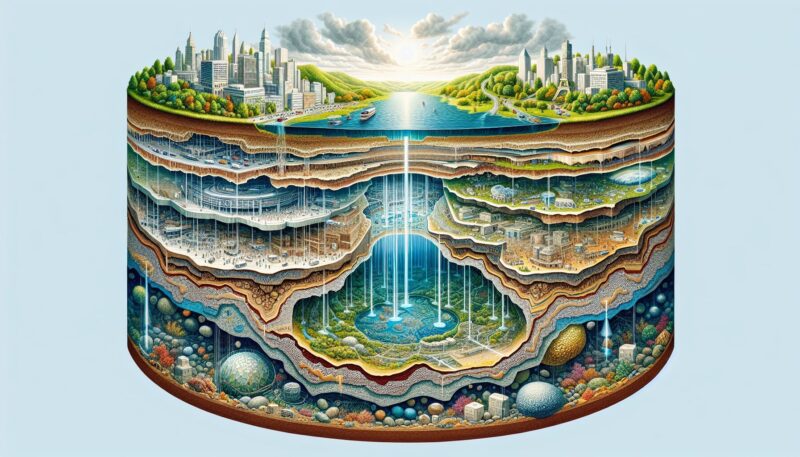
The very essence of life—water—flows beneath us, unseen, in abundant reservoirs known as aquifers. Groundwater, the precious resource found within these natural underground storages, is a crucial contributor to human livelihoods, agricultural sustenance, and ecological balance. This article embarks on an exploration of the depths, unveiling the mysteries and mechanics of groundwater and aquifers, while touching upon the elements that threaten their purity and existence.
What is Groundwater?
Groundwater is the water located beneath the Earth’s surface, filling the porous spaces in soil, sediment, and rocks. It accounts for approximately 30% of the world’s fresh water supply, excluding the massive quantities trapped in ice caps and glaciers. The importance of groundwater cannot be overstated—it not only supplies drinking water for more than half the global population but also irrigates crops, sustains streams during dry periods, and maintains wetland habitats.
The Hydrosphere’s Hidden Component: Aquifers Explored
An aquifer is essentially a geological formation that can store and transmit water. These formations can range from vast, porous rocks to sand and gravel layers, typically bound by less permeable materials like clay or rock that act as a barrier to water flow.
Types of Aquifers
Aquifers are classified into two main categories:
Confined Aquifers: These aquifers are sandwiched between impermeable rock or clay layers, creating a pressurized environment. Water within confined aquifers may be old, often termed as “fossil water”, as it has been trapped for millennia.
Unconfined Aquifers: These have a permeable layer above and an impermeable layer below. The water level in an unconfined aquifer can rise and fall depending on factors like precipitation and consumption.
The Vital Cycle: Groundwater Movement and the Hydrologic Cycle
Groundwater movement is a component of the broader hydrologic cycle, which diagrams the movement of water above, on, and below the Earth’s surface. The stages relevant to groundwater include:
Infiltration and Percolation
When rain falls to the ground, it doesn’t all run off into rivers or evaporate. Some of it soaks into the ground in a process called infiltration. From there, water slowly percolates through soil and rock layers until it reaches the water table—the boundary between unsaturated soil and the aquifer.
Recharge and Discharge
Recharge areas are where water infiltrates through the soil and adds to an aquifer. Conversely, discharge areas are where groundwater finds its way back to the surface naturally via springs or can seep into rivers and lakes.
The Role of Wells
Wells, bored deep into aquifers, are man-made discharge points. Pumping from wells can lower the water table and, if done unsustainably, deplete an aquifer.
Groundwater Quality and Contaminants
The purity of groundwater is fundamental for health and the environment. However, various contaminants threaten this invisible resource.
Common Contaminants Include:
- Pathogens from sewage or animal waste
- Nutrients, particularly nitrogen and phosphorus, which can cause eutrophication
- Heavy Metals like arsenic and lead from natural sources or industrial processes
- Pesticides and Herbicides from agricultural runoff
- Microplastics, an emerging pollutant, are increasingly found in groundwater sources.
Contaminated groundwater can lead to serious health problems and negatively affect ecosystems.
Protection Measures and Restoration
Efforts to preserve groundwater include sharply monitoring withdrawals, preventing pollution, and enforcing robust land use practices that respect recharge zones. In cases of contamination, advanced bioremediation and filtration technologies can restore water quality.
Managing and Sustaining Aquifers
Aquifer depletion is a growing global concern, especially in arid regions where groundwater is the primary water source. Overexploitation can lead to subsidence—where the ground sinks due to diminishing support from drained pore spaces—and saltwater intrusion in coastal areas.
Sustainable Practices Include:
- Artificial Recharge: Enhancing natural recharge rates through techniques like spreading basins
- Regulated Extraction: Implementing policies to control groundwater withdrawal
- Integrated Water Resources Management (IWRM): Coordinating the use of surface and groundwater resources to maximize efficiency and sustainability.
Challenges Facing Groundwater Reserves
Groundwater is not immune to the challenges of the 21st century. Climate change, for instance, can alter precipitation patterns and consequently recharge rates. Pollution from industry, agriculture, and improper waste disposal can render groundwater unfit for use. Moreover, conflicts arise when multiple users compete for this hidden resource.
Addressing Water Scarcity
Groundwater can be a strategic reserve in times of drought, but its role must be carefully managed to avoid over-reliance. Programs such as rainwater harvesting and greywater reuse can alleviate pressure on aquifers.
Groundwater’s Role in Ecosystems
Groundwater discharge provides essential flows to rivers and wetlands. In arid environments, groundwater-dependent ecosystems are oases of biodiversity. These environments must be protected to preserve the species reliant on them.
Conclusion
Groundwater and aquifers are integral to our planet’s health, economy, and the wellbeing of all its inhabitants. As stewards of the Earth, it is crucial to understand, protect, and sustainably manage this precious resource.
Sources
- “Groundwater and Aquifers,” US Geological Survey (USGS), accessed March 1, 2023, https://www.usgs.gov/special-topic/water-science-school/science/groundwater-and-aquifers
- “Managing Groundwater Sustainably,” Global Water Partnership (GWP), accessed March 1, 2023, https://www.gwp.org/en/GWP-Central-Eastern-Europe/gwp-in-action/stories-of-change/Managing-groundwater-sustainably
Groundwater and the complex systems of aquifers beneath us serve as a lifeline for humanity and the environment. As our understanding of these critical resources deepens, so does the realization that our actions on the surface resonate through the hidden veins of water below. It is imperative that we proceed with a sense of responsibility and urgency to safeguard our subterranean reservoirs to ensure that they continue to nourish life for generations to come.