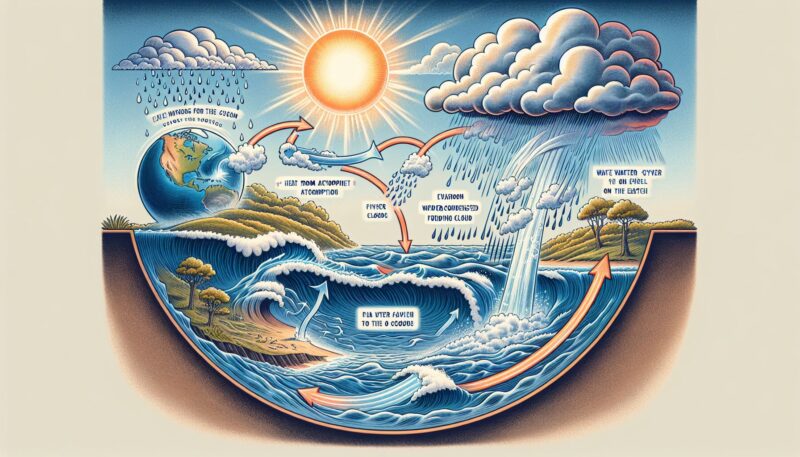
Water is the lifeline of our planet, an essential component for all living organisms and the backbone of Earth’s ecological balance. At the heart of water’s journey through our planet’s systems is the hydrologic cycle. This intricate process describes the continuous movement of water on, above, and below the surface of the Earth, replenishing vital ecosystems and shaping our environment. In this article, we will delve into the fundamentals of the hydrologic cycle, exploring its key processes and their impacts on climate, ecology, and human life.
What is the Hydrologic Cycle?
The hydrologic cycle, often referred to as the water cycle, is a natural process that recycles Earth’s water. It encompasses various stages, including evaporation, transpiration, conditation, precipitation, infiltration, percolation, runoff, and streamflow, which we’ll explore in more depth.
Evaporation
Evaporation is the process where water is converted from its liquid form into vapor. Heated by the sun, water from oceans, lakes, and rivers, as well as from plants and soil, rises into the atmosphere.
Transpiration
Transpiration occurs when plants absorb water from the soil and release it into the atmosphere from their leaves as water vapor. Combined with evaporation, this process is often referred to as “evapotranspiration”.
Condensation
As water vapor rises and cools in the atmosphere, it turns back into liquid droplets, creating clouds. This process is known as condensation.
Precipitation
When these droplets become heavy enough, they fall back to Earth as precipitation, which includes rain, snow, sleet, or hail.
Infiltration
Upon reaching the ground, some of the water infiltrates the soil, replenishing groundwater and aquifers, which are porous rocks that can contain or transmit groundwater.
Percolation
Percolation is the movement of infiltrated water further down through the soil and porous rock layers, replenishing deep underground water supplies.
Runoff
Water that does not infiltrate becomes surface runoff, flowing into rivers, lakes, and eventually oceans. Runoff is an integral part of the hydrologic cycle as it contributes to streamflow.
Streamflow and Baseflow
Streamflow is the movement of water within a river or stream, playing a crucial role in shaping the land and ecosystem. Baseflow is a component of streamflow generated from groundwater seeping into rivers and streams, providing essential support during dry periods.
Groundwater and Aquifers
Groundwater constitutes water found beneath the Earth’s surface. Aquifers are underground layers of water-bearing permeable rock or materials from which groundwater can be extracted using a water well.
Recharge and Discharge
Groundwater recharge is the process where water moves from the surface into the subsurface. Discharge occurs when groundwater flows out of the substrate, typically entering into lakes, rivers, or oceans.
The Hydrologic Cycle and Climate
The hydrologic cycle plays a pivotal role in regulating Earth’s climate. As water moves through its various stages, it carries energy in the form of heat, influencing weather patterns and temperature regulation. Evaporation and transpiration move heat from the Earth’s surface to the atmosphere, cooling the planet, while condensation releases heat into the atmosphere, potentially fueling storm systems.
Hydrologic Cycle and Ecology
The hydrologic cycle also greatly affects our ecosystems. Water is vital for plant and animal life, supporting diverse habitats—from forests and wetlands to grasslands and deserts. Water availability from the cycle’s processes influences the distribution and health of these ecosystems.
Human Impact and Water Management
Humans have drastically impacted the hydrologic cycle through activities such as deforestation, urbanization, and unsustainable water use. Alterations to the land can change runoff patterns, leading to soil erosion, reduced infiltration, and water quality issues. Managing this vital resource through measures like sustainable agriculture, water conservation, and wetland protection is vital.
Water Scarcity and Challenges
With increasing global populations and climate change, water scarcity has become a reality for many regions. Understanding and managing the hydrologic cycle is crucial for ensuring water availability, particularly in areas facing drought, pollution, or over-extraction of groundwater.
Conclusion
The hydrologic cycle is a complex yet essential process for sustaining life on Earth. As we continue to affect this cycle, it’s imperative that we work towards understanding and managing our water resources with care. By recognizing the role each process plays in the cycle, we can adopt strategies that protect and preserve the balance of water within our delicate ecosystems.
Sources
- “The Water Cycle.” United States Geological Survey (USGS). https://www.usgs.gov/special-topic/water-science-school/science/water-cycle
- “What is the hydrologic cycle?” National Oceanic and Atmospheric Administration (NOAA). https://www.noaa.gov/education/resource-collections/freshwater/hydrologic-cycle
- “Ground Water and the Hydrologic Cycle.” Environmental Protection Agency (EPA). https://www.epa.gov/sdwa/ground-water-and-hydrologic-cycle
The hydrologic cycle is nature’s way of providing us with the freshwater necessary for survival. As stewards of this planet, it’s our duty to ensure this cycle remains balanced for future generations. From the clouds above to the soil beneath our feet, every part of the cycle deserves our respect and protection.