The Hydrologic Cycle: Earth’s Vital Water System

Water is the lifeblood of our planet, a crucial resource for all forms of life. It is constantly on the move, cycling through states and locations, from the depths of the ocean to the peaks of mountains. This natural circulation of water is known as the hydrologic cycle, and it plays a key role in shaping our environment and sustaining life. In this article, we’ll delve into the secrets of the hydrologic cycle, exploring its components and their interconnected roles in the Earth’s complex water system.

Understanding the Hydrologic Cycle

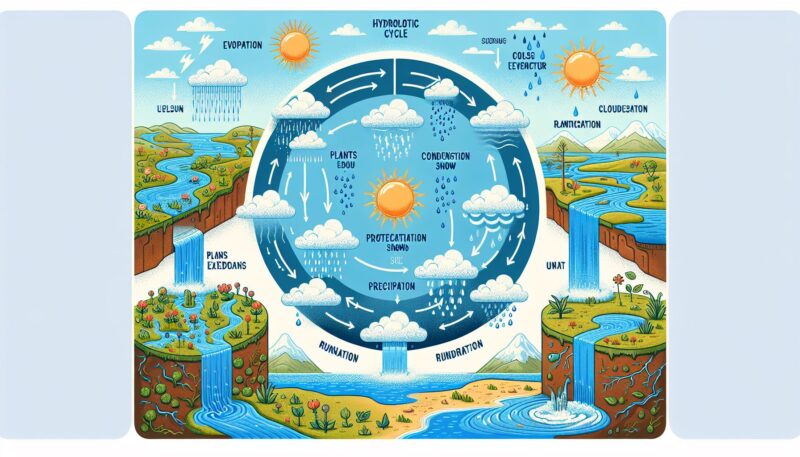
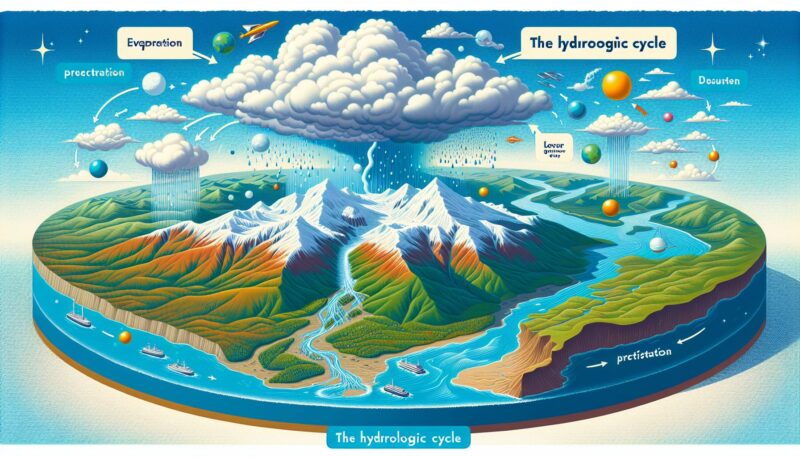
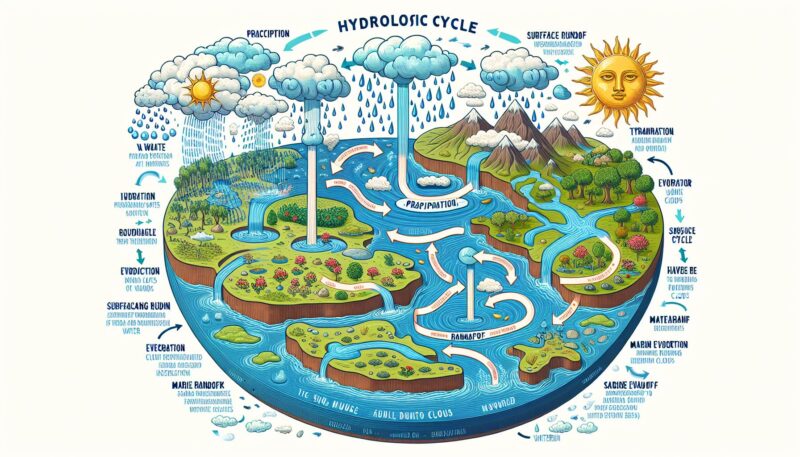
At its core, the hydrologic cycle is the continuous movement of water on, above, and below the Earth’s surface. It’s a complex, never-ending loop that involves various processes such as evaporation, transpiration, condensation, precipitation, and runoff.

Evaporation and Transpiration

The journey of a water molecule often begins in the vast expanse of the oceans, where solar energy heats the surface, causing water to evaporate into the air. This invisible vapor rises into the atmosphere, where cooler temperatures eventually cause it to condense and form clouds.

On land, plants also contribute to the cycle through a process known as transpiration. They draw up groundwater through their roots and release water vapor into the atmosphere from their leaves. Combined with evaporation from soil and other surfaces, this plant-based water loss is a significant part of the hydrologic cycle and is often referred to as evapotranspiration.

Condensation

As the water vapor cools and condenses in the atmosphere, it creates what we recognize as clouds. These clouds, which are simply collections of tiny water droplets and ice crystals, are both a result of and a contributing factor to the planet’s weather patterns. They can drift for miles and serve as a global transport system for water.

Precipitation

Once the clouds are saturated with moisture, or when atmospheric conditions prompt their droplets to coalesce, precipitation occurs. This can take many forms, including rain, snow, sleet, or hail, depending on the temperature and atmospheric conditions. Precipitation is the primary mechanism through which water returns from the atmosphere to the Earth’s surface.

Runoff and Infiltration

Upon reaching the land, not all precipitation follows the same path. Some of it will be absorbed by the soil in a process called infiltration, contributing to groundwater levels. Excess water that doesn’t infiltrate, often due to ground saturation or impermeable surfaces, will travel over the surface as runoff. This runoff feeds into streams, rivers, and eventually back into the oceans, where the cycle can begin anew.

Percolation, Baseflow, and Groundwater

As water infiltrates the soil, it percolates deeper into the ground, replenishing aquifers—natural underground stores of freshwater. From these aquifers, water can flow slowly into streams and rivers, maintaining their levels even during dry periods. This component of streamflow, derived from groundwater, is termed baseflow.

The Role of Ice and Snow

In colder regions, water can be stored in the form of ice and snow, sometimes for prolonged periods. Glaciers and snowpacks act as freshwater reservoirs, releasing water slowly through melting during warmer seasons. This meltwater contributes to river flow and can be a critical source of water for downstream ecosystems and human uses.

The Impact of the Hydrologic Cycle on the Environment

The hydrologic cycle is a primary driver of the Earth’s climate and weather systems. It regulates temperature, shapes landscapes, supports diverse ecosystems, and sustains agriculture. Moreover, the distribution of freshwater across the globe is inherently linked to the cycle, which has profound implications for human societies and natural habitats.

Water Quality and Pollution

As water travels through the hydrologic cycle, it can pick up pollutants from the air, land, and human activities. The quality of water is therefore a crucial concern, affecting not only our environment but also our health and economies. Water pollution, eutrophication from excess nutrients, algal blooms, and the presence of pathogens or toxic substances like heavy metals, microplastics, and chemicals are some of the challenges faced in water management.

Water Treatment and Conservation

As the human population grows and the demand for clean water increases, efforts to manage and purify water supplies have become more critical. Water treatment processes such as filtration, disinfection, chlorination, and more advanced techniques like reverse osmosis and UV irradiation are employed to ensure safe water for consumption and use.

Water conservation strategies are equally important. They include practices like rainwater harvesting, greywater reuse, and reducing overall water footprints to help maintain a sustainable balance in the hydrologic cycle. Awareness of virtual water—the water used in the production of goods and services—is also growing as a means to encourage more responsible consumption patterns.

The Global Importance of the Hydrologic Cycle

The hydrologic cycle connects all regions of the world, making it a global system with local consequences. Water scarcity, droughts, and floods are all manifestations of the cycle’s variability. Understanding and managing the hydrologic cycle is, therefore, a matter of both local and international concern, affecting water security, agriculture, industry, and ecosystems around the world.

Climate Change and the Hydrologic Cycle

The impacts of climate change on the hydrologic cycle are of particular concern, as they can lead to alterations in the distribution and intensity of precipitation, increased evaporation rates, and changes in snow and ice dynamics. These in turn can affect the availability and quality of water resources, with wide-reaching effects on human societies and the natural world.

Conclusion

The hydrologic cycle is an incredible natural process, fundamental to the existence of life and the maintenance of our environment. It is both robust and fragile, capable of supporting vast ecosystems and civilizations, yet vulnerable to our actions and the changing climate. As stewards of this Earth, it is our responsibility to understand and protect the hydrologic cycle, ensuring that it continues to sustain life for generations to come.

Understanding the endless journey of a single water molecule through the hydrologic cycle deepens our appreciation for this vital system and underscores the need for careful management of our planet’s most precious resource.

Sources

The Hydrologic Cycle: Earth’s Vital Water Flow

The hydrologic cycle, also known as the water cycle, is a fundamental concept in hydrology, essential to all life on Earth. Through its continuous series of movements, water travels from the Earth’s surface to the atmosphere and back again, sustaining the planet’s ecosystems and facilitating various weather patterns and climate dynamics.

The hydrologic cycle is a complex, closed-loop system powered by the sun’s energy, driving water’s perpetual motion through various physical states and geographic locations, including rivers, lakes, oceans, atmosphere, and underground reservoirs. This comprehensive article will explore each stage of the hydrologic cycle, illustrate its significance to our planet, and discuss the implications for water quality, ecosystem health, and human usage.

Evaporation: The Ascent of Water Vapor

At the surface of water bodies—oceans, rivers, lakes, and even moist soil—water heats up from solar energy. When it reaches a certain temperature, the water molecules acquire enough energy to break free from liquid form and rise into the atmosphere as vapor, a process known as evaporation. Interestingly, plants also contribute to this atmospheric moisture through transpiration, where water evaporates from the surface of plant leaves.

Transpiration: The Hidden Stream

Transpiration is the lesser-known counterpart to evaporation. In thiskey, plants play a vital role by drawing water from the soil through their roots and releasing it as water vapor through microscopic pores on their leaves, called stomata. This invisible stream significantly contributes to the overall moisture transfer into the atmosphere.

Condensation: Crafting the Clouds

As water vapor rises and the ambient temperature drops, it undergoes condensation. The cooler temperatures at higher altitudes cause water vapor to change back into liquid form, creating clouds composed of tiny water droplets or ice crystals when temperatures are low enough.

Precipitation: Water’s Return to Earth

Precipitation occurs when these droplets grow too heavy to stay airborne, falling to the Earth’s surface as rain, snow, sleet, or hail. The distribution and type of precipitation are influenced by various atmospheric conditions, geographic location, and topography.

Infiltration and Percolation: Water’s Subterranean Journey

Upon reaching the ground, water begins its subterranean journey. Infiltration is the process by which water soaks into the soil, moving through the porous spaces between sediments. Percolation is the next stage, wherein water seeps further down, through the soil layer, reaching the groundwater systems.

Groundwater and Aquifers: The Hidden Reservoirs

Groundwater constitutes a significant portion of the Earth’s fresh water, residing in layers of soil, sand, and rock called aquifers. It moves much slower compared to surface water and can be stored for years, providing a stable supply during dry periods.

Springs and Baseflow: Groundwater’s Emergence

Groundwater naturally emerges at the Earth’s surface through springs or seeps, feeding into rivers and lakes. It also contributes to streams and rivers through baseflow, sustaining water levels especially during periods without rain.

Runoff and Streamflow: The Visible Path

Runoff is the portion of precipitation that doesn’t infiltrate or evaporate, traveling instead across the land’s surface towards larger bodies of water. This surface water collects in streams and rivers, a process known as streamflow, which eventually makes its way to lakes, estuaries, and oceans.

The Integral Role of Glaciers, Icebergs, and Snowpack

Frozen water found in glaciers, icebergs, and snowpack also plays a crucial role in the hydrologic cycle. They act as long-term storage for freshwater, and their seasonal melt contributes to rivers and streams, affecting water availability downstream.

Human Impacts on the Hydrologic Cycle

Human activities have a profound impact on the water cycle. Urbanization increases impermeable surfaces, altering runoff patterns and potentially leading to increased flooding. Agriculture can modify transpiration rates, and water withdrawals for industry and consumption can reduce surface water and groundwater levels.

Water Quality and Pollution

Water quality is pivotal in determining the health of ecosystems and the suitability of water for human use. Pollution from chemicals, nutrients, pathogens, and microplastics can adversely affect water at every stage of the hydrologic cycle, with serious ramifications for all living organisms.

Climate Change and the Hydrologic Cycle

Climate change is altering the hydrologic cycle in significant ways, affecting the distribution and intensity of precipitation, accelerating the melting of ice and snow, and increasing evaporation rates. These changes can lead to more extreme weather events like droughts and floods, which have dire consequences for habitats, agriculture, and human settlements.

The Necessity of Water Management

Given the finite nature of freshwater resources and the growing demand, effective water management practices are essential. This involves water treatment processes such as reverse osmosis, chlorination, and ozonation; water distribution systems; and conservation strategies like rainwater harvesting and greywater reuse.

Conclusion

The hydrologic cycle is a testament to the dynamic nature of water on our planet. Understanding its many phases and the factors that influence it is crucial for managing our water resources sustainably and ensuring the survival of diverse life forms on Earth. As climate change and human activities present new challenges to this delicate system, a focus on science and policy is more important than ever to maintain the balance of this invaluable cycle.

Sources

“`

Unraveling the Mysteries of the Hydrologic Cycle: Earth’s Vital Water Exchange System

Water, a resource so crucial to life and the environment, undergoes a continuous and fascinating journey through the hydrologic cycle. This complex process is the engine that drives the movement, distribution, and quality of Earth’s water resources. Here, we will delve into the science behind the hydrologic cycle, its various stages, and its significance to our planet.

Understanding the Hydrologic Cycle

The hydrologic cycle, also known as the water cycle, is the continuous movement of water on, above, and below the surface of the Earth. This cycle consists of several crucial processes: evaporation, transpiration, condensation, precipitation, infiltration, percolation, runoff, and storage.

Evaporation

Evaporation is the process where water is transformed from a liquid to a gas. Heated by the sun, water from oceans, rivers, lakes, and even soil rises into the atmosphere. This is the primary method for water to transition from Earth’s surface into the atmosphere.

Transpiration

Transpiration, often considered in tandem with evaporation, is the process by which moisture is carried through plants from roots to small pores on the underside of leaves, where it changes to vapor and is released into the atmosphere. The combination of evaporation and transpiration is termed evapotranspiration.

Condensation

Condensation, the opposite of evaporation, occurs when water vapor in the air cools down and changes back into liquid form. This process creates clouds and fog. Condensation is a critical process in the water cycle as it leads to precipitation.

Precipitation

Precipitation occurs when so much water has condensed that the air cannot hold it anymore. The clouds release the water in different forms such as rain, snow, sleet, or hail depending on the atmospheric conditions.

Infiltration

Some of the water that precipitates onto land infiltrates into the subsurface soil and porous rock, thus replenishing aquifers, which are underground layers of water-bearing permeable rock or materials such as gravel, sand, silt, or clay.

Percolation

Percolation refers to the movement of water through the pores in the soil or rocks. This movement of water filters and cleans it before it reaches the aquifers.

Runoff

When precipitation falls on the land surface, not all of it infiltrates into the ground. Some water flows as runoff over the land surface and into bodies of water such as streams, rivers, ponds, and lakes.

Storage

Water is stored in different forms. This includes the water in the atmosphere, surface water in rivers and lakes, ice in glaciers, underground in aquifers, and in biological organisms.

Groundwater Movement

An often-overlooked aspect of the hydrologic cycle, groundwater movement is the flow of water that takes place below the Earth’s surface. This is an integral part of maintaining the water balance and supporting ecosystems, agriculture, and human needs.

The Significance of the Hydrologic Cycle

The hydrologic cycle is of paramount importance for several reasons:

  • Regulating Climate: By transferring heat from the tropics to the poles, and from the Earth’s surface to the atmosphere and back, the hydrologic cycle plays a critical role in regulating Earth’s climate.
  • Supporting Ecosystems: Water is a habitat for countless species, and the cyclical movement of water is essential for the survival of aquatic and terrestrial ecosystems.
  • Sustaining Human Life: Clean water for drinking, agriculture, sanitation, and industrial uses relies on the continuous movement and renewal of water through the hydrologic cycle.

Human Impacts on the Hydrologic Cycle

Human activities are now influencing the hydrologic cycle in profound ways:

  • Climate Change: Altered precipitation patterns, increased evaporation rates, and accelerated glacier melt are some of the ways in which climate change is impacting the hydrologic cycle.
  • Land Use Changes: Deforestation, urbanization, and the creation of impervious surfaces interrupt natural infiltration and increase runoff, leading to flooding and the degradation of water quality.
  • Water Withdrawals: Excessive withdrawal of freshwater for agriculture, industry, and domestic use is altering the natural water balance, leading to depleted aquifers and lowered water tables.

Looking to the Future: Protecting the Hydrologic Cycle

To ensure a sustainable future, we need to protect the hydrologic cycle:

  • Conservation efforts must focus on reducing water usage and recycling water where possible.
  • Rainwater harvesting can mitigate the effects of runoff and provide additional water resources.
  • Protecting wetlands and restoring natural landscapes can improve infiltration and water quality.
  • Water management policies and infrastructure developments should be based on a sound understanding of the hydrologic cycle to ensure the wise use and distribution of water resources.

Conclusion

The hydrologic cycle is a complex but vital system that maintains life on our planet. Understanding how it works is crucial for managing our water resources sustainably. By respecting and preserving this natural cycle, we ensure the survival and prosperity of future generations.

Sources

Understanding the Hydrologic Cycle: Earth’s Vital Water Movement

The hydrologic cycle, often known as the water cycle, is a continuous and dynamic process that describes the movement of water above, on, and below the surface of the Earth. It is a critical natural mechanism that has profound implications for climate, ecosystem sustenance, and human activities.

The Phases of the Hydrologic Cycle

The hydrologic cycle is made up of several processes that work in harmony. These include evaporation, transpiration, condensation, precipitation, infiltration, percolation, runoff, and ground storage.

Evaporation and Transpiration: The Upward Journey

Evaporation is the process of water turning from a liquid into a vapor. It chiefly occurs on the surface of bodies of water, like rivers, lakes, and oceans, under the influence of the sun’s heat. Transpiration, on the other hand, happens when plants release water vapor from their leaves into the atmosphere. Together, these processes contribute to the atmospheric moisture that is essential for cloud formation. They also play a role in regulating temperature as evaporation causes cooling effects.

Condensation: The Birth of Clouds

As water vapor rises, it cools and transforms into tiny droplets of liquid or ice crystals when the air reaches saturation. This is known as condensation. The collection of water droplets or ice crystals suspended in the air forms clouds. The type and height of clouds are determined by the temperature, air pressure, and water vapor present in the atmosphere.

Precipitation: The Descent of Water

Precipitation occurs when droplets of water in clouds combine to become large enough to fall due to gravity. This falling moisture can take several forms, including rain, snow, sleet, or hail, depending on the atmospheric conditions it encounters on its descent. Precipitation is the primary way water is delivered from the atmosphere back to the Earth’s surface, filling our lakes, rivers, and aquifers.

Infiltration and Percolation: Water’s Underground Journey

Once water reaches the ground, it can either flow over the surface as runoff or it can infiltrate the soil. Infiltration refers to water entering the soil surface and percolation describes the movement of water through soil and porous rock formations downward into aquifers, which are the underground layers of water-bearing permeable rock.

Runoff and Streamflow: Rivers on the Move

Runoff is the part of precipitation that flows over the land’s surface and is collected in rivers, streams, and eventually, the ocean. It can be affected by factors such as rainfall intensity, land use, and topography. Streamflow is the actual flow of water in streams and rivers, moving towards larger bodies of water. It plays a critical role in shaping the landscape and providing habitats for a wealth of biodiversity.

Groundwater: A Hidden Resource

Beneath our feet lies one of the most important sources of fresh water: groundwater. It fills the cracks and spaces in the soil, sand, and rock and can be stored in large reservoirs known as aquifers. Aquifers are vital for providing water for drinking, irrigation, and industrial use. Ground-stored water can remain in aquifers for centuries, or emerge as springs or feed into rivers during drier periods, supplying a steady baseflow.

Recharge and Discharge: The Aquifer Exchange

Recharge refers to the process of adding water to an aquifer, predominantly through rainfall and snowmelt that percolates down through the ground. Discharge, on the other hand, happens when water is removed from an aquifer, whether through natural springs or human extraction for consumption and use. The balance between recharge and discharge is important to maintain the sustainability of groundwater resources.

The Importance of the Hydrologic Cycle

The hydrologic cycle is nature’s way of providing renewable water resources. It not only supports the wide array of plant and animal life on our planet but is also essential for human societies, fueling agriculture, industry, and everyday life.

Environmental and Climatic Influence

The water cycle plays a significant role in climate regulation by transporting heat energy through the movement of water. It also shapes our world’s landscapes through erosion and deposition, greatly influences weather patterns, and is a key factor in the natural purification of our water.

Human Impact on the Hydrologic Cycle

Human activities have significantly altered the water cycle. The creation of impervious surfaces, deforestation, pollution, and the emission of greenhouse gases affect evaporation, condensation, and precipitation. Additionally, over-extraction of groundwater for agriculture, industry, and personal use can lead to depletion and reduced recharge rates.

Water-related Challenges

The challenges facing our water resources are multifaceted. Issues such as water pollution, eutrophication, algal blooms, changes in precipitation patterns, and extreme weather conditions all pose threats to water quality and availability. Climate change exacerbates these issues further, making the understanding and protection of the hydrologic cycle more crucial than ever.

Conservation and Management Strategies

Conserving and managing our water resources is vital. Strategies for this include the development of efficient water treatment and distribution systems, the implementation of rainwater harvesting and greywater reuse, and the promotion of water conservation practices among the public.

Additionally, preserving natural landscapes like wetlands and forests can maintain the integrity of the hydrologic cycle by promoting infiltration and groundwater recharge while also providing natural filtration for improved water quality.

Addressing Water Scarcity and Pollution

Water scarcity and pollution are significant global problems that need concerted efforts to address. Improved farming practices, the reduction of industrial discharges, and increased investment in water treatment technologies can all play a role.

Desalination and advanced water treatment methods such as reverse osmosis, ozonation, and ultrafiltration are becoming more widespread to provide clean water from non-traditional sources, although these need to be energy-efficient and sustainable.

Water Diplomacy and Cooperation

The finite nature of water resources requires that nations cooperate to manage shared rivers and lakes through water diplomacy. Disputes over water can lead to conflict, but well-designed agreements can facilitate fair water sharing and mutual benefits.

The Future of Hydrology

As our understanding of the hydrologic cycle advances, so too can our ability to harness and protect this precious resource. Using technologies like remote sensing, computer modeling, and data analytics, scientists are increasingly able to predict and respond to water-related issues.

Moreover, public education and policy initiatives are critical in ensuring that water use is sustainable and our ecosystems are preserved. By appreciating the value and functions of the hydrologic cycle, we can take responsible actions towards a water-secure future for all.

Conclusion

The hydrologic cycle is an indispensable component of Earth’s system. Our existence and the health of the environment depend on the equitable and sustainable management of this cycle. As individuals and communities across the planet become more water-conscious, there is hope for resilient and adaptive strategies that can meet the challenges posed by a changing climate and increased water demand.

Sources

  1. U.S. Geological Survey. (n.d.). The Water Cycle. https://www.usgs.gov/special-topics/water-science-school/science/water-cycle
  2. United Nations Water. (