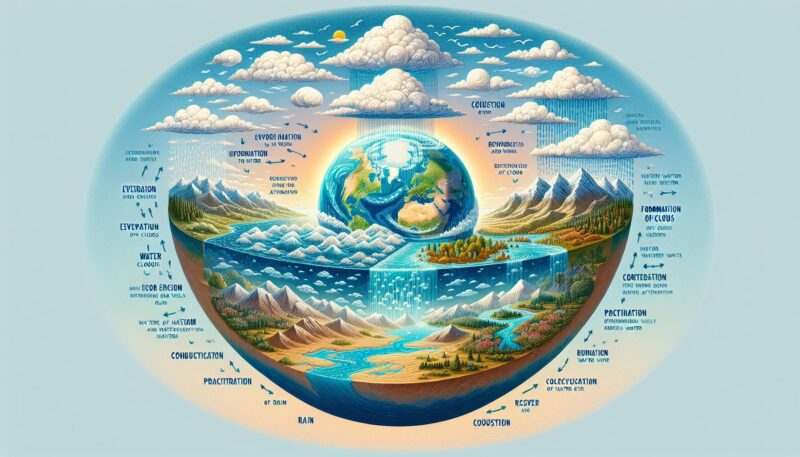
The hydrologic, or water, cycle is a continuous process by which water is circulated throughout the Earth’s hydrosphere. It is a complex system that involves the movement of water in its various phases – liquid, solid, and gas – through the atmosphere, onto land, into and out of bodies of water, and through living organisms. In this detailed exploration, we’re going to delve deep into the hydrologic cycle, unraveling its components, significance, and the current challenges it faces.
The Components of the Hydrologic Cycle
Evaporation
As the sun heats the surface of the Earth, water from oceans, rivers, lakes, and other bodies of water turns into vapor in a process known as evaporation. Plants also contribute to the vapor in the atmosphere through transpiration, which is the release of water vapor from plant leaves. These two processes are often collectively referred to as evapotranspiration.
Condensation
The water vapor eventually cools as it rises higher in the atmosphere and condenses into tiny droplets forming clouds. This process is known as condensation. These water droplets collide and grow, leading to the formation of precipitation.
Precipitation
Precipitation occurs when the droplets become heavy enough to fall under gravity’s influence. It can take many forms, such as rain, snow, sleet, or hail, depending on the atmospheric conditions.
Infiltration and Percolation
Once precipitation reaches the ground, it can take several pathways. Some of the water is absorbed into the soil, a process called infiltration, and percolates down to recharge aquifers – this signifies percolation. This infiltrated water can become groundwater, which feeds springs and can resurface in bodies of water.
Runoff and Streamflow
The remaining water flows across the land’s surface as runoff. Runoff contributes to streamflow, the water running in rivers and streams, which eventually leads to a lake, a reservoir, the ocean, or other bodies of water.
Baseflow
Baseflow is the portion of the streamflow that is sustained between rainfall events, fed into streams by delayed pathways such as groundwater seeping into the river bed.
Integral Players in the Hydrologic Cycle
Aquifers
An aquifer is an underground layer of water-bearing permeable rock, rock fractures, or unconsolidated materials from which groundwater can be extracted. Some aquifers, known as confined aquifers, are trapped between layers of relatively impermeable rock or clay. Others, unconfined aquifers, can receive water directly from the surface.
Watershed, Catchment, and Drainage Basin
A watershed or catchment is an area of land that separates waters flowing to different rivers, basins, or seas. It’s a crucial concept for managing water resources. The term drainage basin also represents a similar concept, often used interchangeably with a watershed.
Groundwater and Recharge
Groundwater is the water that fills the cracks and spaces in underground soil and rock layers. Recharge is the process by which groundwater is replenished, usually through the processes of infiltration and percolation.
Discharge
Discharge is the flow of groundwater into rivers, lakes, and the ocean, which is usually a result of groundwater permeability and pressure.
Importance of the Hydrologic Cycle
The hydrologic cycle is essential for the distribution and management of Earth’s water resources. Apart from maintaining ecological balance, it supports human life by providing fresh water for drinking, irrigation in agriculture, and industrial processes.
Regulation of Climate
By transferring heat and energy through the evaporation and precipitation processes, the hydrologic cycle contributes significantly to the regulation of climate. Water vapor is a critical greenhouse gas that traps heat in the atmosphere.
Supporting Ecosystems
Ecosystems thrive on the balanced cycling of water. Many species are adapted to specific water conditions and depend on the timing of the hydrologic cycle’s various processes.
Providing Freshwater
Groundwater, which is part of the hydrologic cycle, serves as a crucial reservoir of freshwater. It is especially significant during periods of drought or when surface water from lakes, rivers, and reservoirs is scarce.
Challenges Threatening the Hydrologic Cycle
Climate Change
Climate change is altering precipitation patterns and intensifying the hydrologic cycle, leading to extreme weather events like floods and droughts, making water availability more unpredictable.
Water Quality and Pollution
The quality of water is as essential as its quantity. Water pollution from industrial waste, agricultural runoff containing pesticides and fertilizers, and sewage discharge affects the integrity of the hydrologic cycle. Instances of eutrophication and algal blooms due to excessive nutrient runoffs degrade water bodies, affecting aquatic life and water quality.
Overextraction of Groundwater
Unsustainable extraction of groundwater for irrigation and urban use can lead to a decrease in water levels called overdraft, which in turn leads to a cascade of environmental problems including reduced streamflow, degradation of water quality, and land subsidence.
Infrastructure and Urbanization
Infrastructure development and urbanization change the natural landscape, often leading to reduced infiltration, increased runoff, and heightened risk of flooding. Surfaces like concrete and asphalt are impermeable and do not allow precipitation to infiltrate the ground.
Global Water Crisis
The imbalance in the distribution of freshwater resources and inequitable access are leading to a global water crisis, where water scarcity and water stress are becoming increasingly common, particularly in arid regions and rapidly growing cities.
Mitigating Challenges and Managing the Hydrologic Cycle
Water Conservation and Sustainable Management
Implementing water conservation strategies, such as rainwater harvesting and greywater reuse, is vital for reducing pressure on the hydrologic cycle. Additionally, integrated water resources management (IWRM) is necessary to balance the demands on water resources among various sectors.
Upgrading Water Treatment and Distribution
Advancements in water and wastewater treatment technologies, including reverse osmosis, filtration, chlorination, and ozonation, can help ensure that the water we return to the cycle is clean and free from pollutants. Upkeep of water distribution systems, such as maintaining water towers, pumping stations, and pipe networks, also ensures water quality and reduces losses.
Water Diplomacy and Conflict Resolution
As water becomes scarce, the potential for conflict over water resources increases. Water diplomacy is the use of diplomatic means to negotiate shared water resources and prevent conflicts.
Adaptation to Climate Change
Adapting infrastructure to better cope with climate change can reduce vulnerability to altered hydrologic patterns. Moreover, policies aimed at mitigating climate change can slow the rate of change within the hydrologic cycle.
Conclusion
The hydrologic cycle is a fundamental ecological process that underpins life on Earth. Human activity and climate change are putting pressure on it, altering its balance