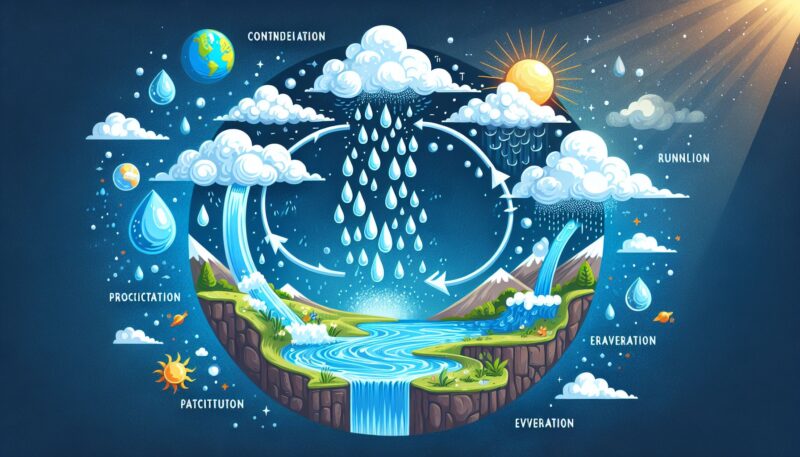
The hydrologic cycle, also known as the water cycle, is the continuous movement of water on, above, and below the surface of the Earth. It is a complex system that sustains life by regulating the climate, shaping the Earth’s surface, and providing fresh water to all organisms. In this comprehensive overview, we will delve deeply into the hydrologic cycle, exploring its processes and their significance, the threats posed by human activities, and the measures adopted to maintain water balance on our planet.
The Components of the Hydrologic Cycle
The hydrologic cycle consists of several key processes – precipitation, evaporation, transpiration, condensation, infiltration, percolation, runoff, streamflow, baseflow, and groundwater flow – each playing a distinct role in water distribution:
- Precipitation: The primary way water returns from the atmosphere to the Earth. It includes rain, snow, sleet, and hail.
- Evaporation: The transformation of liquid water into vapor, which then enters the atmosphere.
- Transpiration: The process by which plants absorb water through their roots and release it as vapor through their leaves.
- Condensation: When water vapor cools in the atmosphere and transforms into liquid or ice, forming clouds.
- Infiltration: The movement of water from the surface into the soil.
- Percolation: The downward flow of water through soil and rocks, which can eventually replenish aquifers – the underground layers of water-bearing permeable rock.
- Runoff: The movement of water, usually from precipitation, across the Earth’s surface, which can lead to streamflow – the flow of water in streams and rivers.
- Baseflow: The portion of streamflow that is sustained between precipitation events, fed by groundwater seepage into rivers and streams.
- Groundwater flow: The flow of water beneath the Earth’s surface within aquifers.
The Importance of Each Process
Each stage of the hydrologic cycle plays an essential role in Earth’s ecology and human livelihood:
- Precipitation not only replenishes freshwater resources but also influences various ecosystems by providing necessary hydration.
- Evaporation and transpiration help regulate the Earth’s temperature and contribute to cloud formation.
- Condensation, paired with adiabatic cooling (when air expands and cools), leads to precipitation.
- Infiltration and percolation are vital filtration processes that purify water as it passes through layers of soil and rock.
- Runoff impacts soil erosion and sediment transport, shaping landscapes.
- Baseflow is crucial for maintaining ecosystems in rivers and streams during dry periods.
- Groundwater flow ensures the sustainability of aquifers, which are critical sources of drinking water.
The Role of Water Bodies in the Hydrologic Cycle
Oceans
Oceans are the largest storage of Earth’s water and a key component of the hydrological cycle. They cover more than 70% of the Earth’s surface and contribute largely to global evaporation and precipitation.
Lakes, Reservoirs, and Wetlands
Lakes, artificial reservoirs, and wetlands act as temporary storage spots for fresh water and play roles in flood control, water purification, and habitat provision.
Rivers and Streams
Rivers and streams are conduits for moving water across the land, often transporting nutrients and sediments, and are integral to human societies and ecosystems.
Glaciers and Snowpacks
Glaciers and seasonal snowpacks store significant amounts of freshwater. The meltwater from these sources is vital for rivers and streams, particularly during warmer months.
Groundwater and Aquifers
Groundwater, which is stored in aquifers, serves as a crucial supply of fresh water for agricultural, industrial, and personal use. It is less susceptible to contamination and serves as a buffer during drought.
Human Impacts on the Hydrologic Cycle
Intensive human activities like deforestation, urbanization, and industrialization have dramatically altered the natural hydrologic cycle:
- Deforestation reduces transpiration and thus affects precipitation patterns.
- Urbanization increases surface runoff, reducing infiltration and potentially leading to increased flooding.
- Industrialization often leads to water pollution, which can damage the quality of both surface water and groundwater.
Additionally, climate change, driven by human-induced greenhouse gas emissions, is causing shifts in the hydrologic cycle. Changes in temperature can alter evaporation rates, affect snow and ice melt, and shift precipitation patterns, leading to droughts in some regions and floods in others.
Water Quality and Pollution
Water quality is impacted by pollutants like heavy metals, pathogens, nutrients, microplastics, and chemicals, which can enter water sources through runoff, industrial discharges, and improper waste disposal. Pollutants can lead to detrimental health effects in humans and wildlife and disrupt aquatic ecosystems.
Processes like eutrophication can result from nutrient overload, often from agricultural runoff, leading to excessive growth of algae and subsequent depletion of dissolved oxygen – a phenomenon known as an algal bloom.
Protection and Management of Water Resources
Effective management of water resources is crucial to maintaining the balance of the hydrologic cycle. It involves:
- Water treatment processes, which include filtration, disinfection, and advanced techniques like reverse osmosis, to ensure clean drinking water.
- Water conservation practices, such as rainwater harvesting, greywater reuse, and efficient irrigation methods, to minimize wastage.
- Protection of watersheds and catchment areas to sustain the natural flow and quality of water.
- Infrastructure maintenance, including leakage detection in pipe networks and proper construction and management of dams and reservoirs.
Water-Related Challenges and Global Initiatives
Water scarcity, along with water stress, affects billions around the world. Climate change exacerbates the frequency and severity of droughts and floods, putting additional pressure on already-stressed water systems.
International efforts like water diplomacy and treaties aim to address transboundary water conflicts and promote shared, sustainable management of water resources.
Conclusion
The hydrologic cycle is a complex yet delicate system that governs the distribution and quality of water on our planet. Understanding and preserving this cycle is fundamental for the sustainability of all life on Earth. As populations grow and climates change, managing this vital resource responsibly will be one of humanity’s most significant challenges.
Further Reading and Sources
- United States Geological Survey (USGS) – The Water Cycle. https://www.usgs.gov/special-topics/water-science-school/science/water-cycle
- National Oceanic and Atmospheric Administration (NOAA) – The Global Water Cycle. https://www.noaa.gov/education/resource-collections/freshwater/global-water-cycle
- World Health Organization (WHO) – Water. https://www.who.int/health-topics/water#tab=tab_1