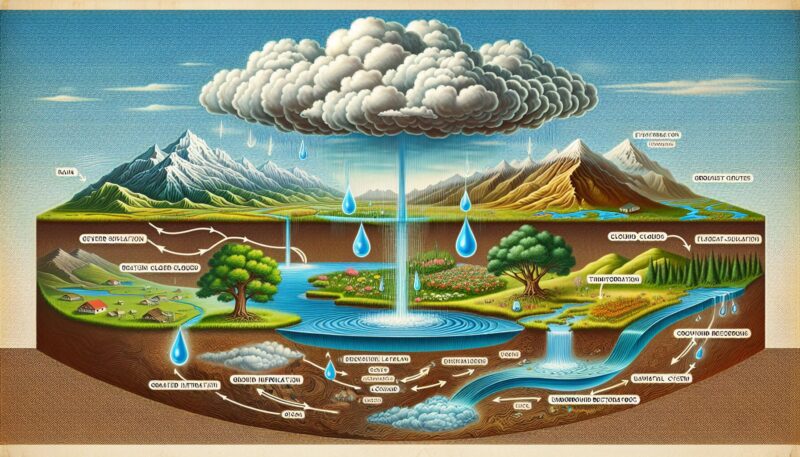
Water is the essence of life on our planet. It shapes our geography, dictates ecosystems, and is fundamental to our existence. At the heart of the global water system is the hydrologic cycle—a continuous process that circulates water around the Earth. This article delves deep into the mechanisms of the hydrologic cycle, exploring its various stages and the critical role it plays in sustaining life and the environment.
What Is the Hydrologic Cycle?
The hydrologic cycle, also known as the water cycle, is the continuous movement of water within the Earth and its atmosphere. This cycle is driven primarily by the energy from the sun and involves a series of intricate processes—evaporation, transpiration, condensation, precipitation, infiltration, percolation, runoff, and more—that work together to distribute water across different parts of our planet.
The Stages of the Hydrologic Cycle
- Evaporation: The transformation of water from liquid to vapor when it absorbs heat from the sun.
- Transpiration: The process by which water evaporates from plants and soil into the atmosphere.
- Condensation: As water vapor rises and cools, it changes back into liquid form, creating clouds.
- Precipitation: When water droplets in clouds combine and become heavy enough, they fall as rain, snow, sleet, or hail.
- Infiltration: The process where water seeps into the soil from the surface.
- Percolation: Water continues to move down through the soil, reaching the groundwater.
- Runoff: Water that doesn’t infiltrate into the ground flows over the surface towards rivers, lakes, and oceans.
- Streamflow/Baseflow: Water in rivers can be a combination of runoff and groundwater feeding into the river system.
- Groundwater: Water beneath the Earth’s surface that fills spaces in soil, sand, and rocks.
The Integral Elements and Their Functions
The hydrologic cycle is a complex system that involves numerous elements, each contributing uniquely to this natural phenomenon.
- Aquifers: Underground layers of water-bearing rocks or materials that store groundwater.
- Recharge: The process where water from precipitation and runoff enters an aquifer.
- Discharge: When groundwater flows out of an aquifer, such as into a spring or river.
- Watershed/Catchment/Drainage Basin: An area of land where all precipitation collects and drains off into a common outlet such as a river, bay, or other body of water.
- Ocean: The largest storage area for Earth’s water, oceans are crucial for evaporation and influencing climate.
- Glacier and Iceberg: Glaciers store frozen water on land, while icebergs are floating pieces that have broken off from glaciers.
- Permafrost: A layer of permanently frozen ground that can impact the infiltration and storage of water.
- Snowpack: Accumulated snow that, upon melting, contributes to runoff and streamflow.
Impact on the Environment and Life
The hydrologic cycle is essential for maintaining the health and balance of our ecosystems. It supports plant and animal life, shapes our landscapes by natural erosion and sediment transport, and provides fresh water for drinking, agriculture, and industry.
Moreover, the global climate system is intricately connected with the hydrologic cycle. The distribution and temperature of water play vital roles in weather patterns and climatic conditions across the globe.
Human Interaction with the Hydrologic Cycle
Human activities have a significant impact on the hydrologic cycle. Land development, agriculture, water withdrawal for consumption and industry, and pollution alter natural processes, which can lead to environmental concerns such as:
- Water Pollution: Contamination by substances, reducing water quality and harming ecosystems.
- Eutrophication and Algal Bloom: High nutrient levels, often from agricultural runoff, leading to excessive plant growth and oxygen depletion in water bodies.
- Drought and Flood: Changes in land use and climate can affect precipitation patterns, leading to more frequent droughts or flooding.
- Water Scarcity and Stress: Overexploitation and mismanagement of water resources can result in insufficient water supply to meet human and environmental needs.
Solutions and Conservation
To mitigate human impact on the hydrologic cycle, several strategies can be implemented:
- Water Conservation: Using water efficiently and reducing waste.
- Rainwater Harvesting: Collecting and storing rainwater for reuse.
- Greywater Reuse: Treatment and use of wastewater from domestic activities (except toilet flushing) for irrigation and other purposes.
- Water Treatment Technologies: Systems such as reverse osmosis, filtration, and disinfection can help improve water quality.
- Protecting Watersheds and Wetlands: Preserving these natural water storage and filtration systems.
Water Education and Awareness
Educating the public on the importance of the hydrologic cycle and responsible water use can lead to more sustainable practices. Awareness campaigns, regulations, and incentives for water-saving technologies can go a long way in preserving our precious water resources.
Conclusion
The hydrologic cycle is a vital and dynamic system that sustains life on Earth. Understanding and respecting its processes is essential for maintaining the delicate balance of our environment. It is our collective responsibility to ensure that this natural resource is managed wisely for the benefit of all living creatures and future generations.
Sources
- U.S. Geological Survey, The Water Cycle, https://www.usgs.gov/special-topic/water-science-school/science/water-cycle
- National Oceanic and Atmospheric Administration (NOAA), The Water Cycle, https://www.weather.gov/jetstream/wcycle
- United Nations World Water Assessment Programme, http://www.unwater.org/publications/world-water-development-report-2018/