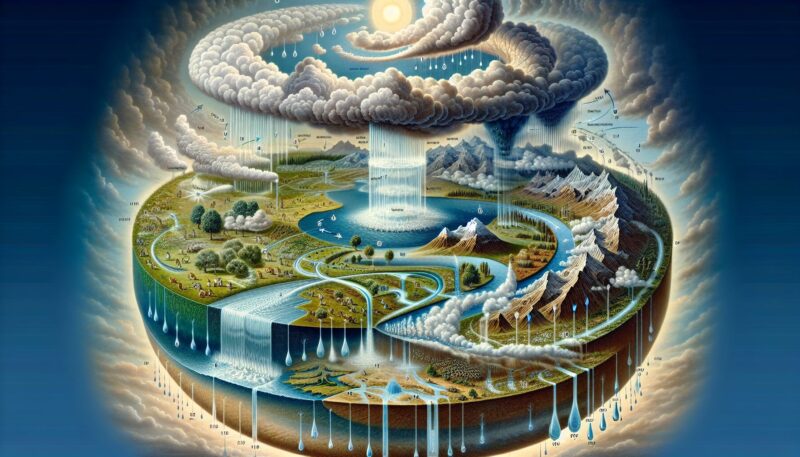
Hydrology is a science that encompasses the study of water on Earth. It involves understanding the properties, distribution, and movement of water across the planet. Water, a vital element for all living organisms, shapes Earth’s landscape and is crucial in ecological and human systems. This article provides an in-depth look at hydrology, focusing on key aspects like the hydrologic cycle, aquifers, and water treatment.
What is Hydrology?
Hydrology is the scientific study of the movement, distribution, and management of water on Earth and other planets, including the water cycle, water resources, and environmental watershed sustainability. Hydrologists study how water influences the environment and how the environment impacts water resources.
The Hydrologic Cycle
The hydrologic cycle, also known as the water cycle, is a continuous process by which water is circulated throughout the Earth’s atmosphere, land, and oceans. The cycle involves various stages: evaporation, transpiration, condensation, precipitation, infiltration, runoff, and sub-surface flow.
Evaporation
Evaporation is the process by which water is transformed from liquid to vapor and is primarily powered by the sun’s energy. This occurs over bodies of water like oceans, lakes, and rivers, as well as moist soil and wet vegetation.
Transpiration
Transpiration involves the release of water vapor from plants and soil into the air. When combined with evaporation, the total process is often referred to as evapotranspiration.
Condensation
Condensation is the process by which water vapor in the air is changed into liquid water, forming clouds and fog. This is crucial in the formation of precipitation.
Precipitation
Precipitation occurs when condensed water in the atmosphere falls to the ground in the form of rain, snow, sleet, or hail.
Infiltration
Infiltration is the process by which water on the ground surface enters the soil. The rate of infiltration can depend on soil characteristics, vegetation, and land use.
Percolation
Percolation is the downward movement of water through soil and rock layers, which can eventually replenish aquifers (underground layers of water-bearing permeable rock, rock fractures, or unconsolidated materials).
Runoff
Runoff is the flow of water that occurs when excess stormwater, meltwater, or other sources can’t infiltrate the ground and consequently flows over the Earth’s surface.
Streamflow and Baseflow
Streamflow is the flow of water in streams, rivers, and other channels, while baseflow is the portion of this flow that comes from groundwater seeping into the streambed.
Groundwater and Aquifers
Groundwater is the water held underground in the soil or in pores and crevices in rock. An aquifer is a body of permeable rock which can contain or transmit groundwater. There are two types of aquifers:
- Confined Aquifer: This aquifer is sandwiched between two impermeable layers of rock or clay and is under pressure.
- Unconfined Aquifer: An aquifer that is not overlain by an impermeable layer and where water is not under pressure.
Recharge and Discharge
Recharge is the process by which groundwater is replenished, often through processes like infiltration and percolation. Discharge is when groundwater flows out of an aquifer, typically at a spring or into the sea.
Hydrological Measurement and Analysis
Hydrologists use various tools and techniques to measure and analyze different components of the hydrologic cycle. This includes:
- Stream gauges to measure streamflow
- Rain gauges to quantify precipitation
- Weather satellites and radar for remote sensing
- Groundwater monitoring wells for aquifer levels
Watershed, Catchment, and Drainage Basin
These terms are often used interchangeably to define the land area that channels rainfall and snowmelt to creeks, streams, and rivers, and eventually to outflow points such as reservoirs, bays, and the ocean. Management of watersheds is crucial in ensuring sustainable water resources.
Water Quality and Pollution
Water quality refers to the chemical, physical, and biological characteristics of water in relation to its suitability for a particular purpose, such as drinking, swimming, or host aquatic life. Water pollution, on the other hand, is the contamination of water bodies, typically due to human activities. Key indicators of water quality include:
Dissolved Oxygen
The amount of oxygen dissolved in water, crucial for the survival of aquatic organisms.
pH
A measure of the acidity or alkalinity of water, which affects the solubility and biological availability of chemical constituents.
Turbidity
The cloudiness or haziness of water caused by large numbers of individual particles.
Nutrients
The concentration of essential elements like nitrogen and phosphorus, which in excess quantities can lead to issues like eutrophication.
Water Treatment Processes
Water treatment is essential for providing safe drinking water. It involves several processes, such as:
- Filtration: Removing particulates by passing water through filters.
- Disinfection: Using chlorine, ultraviolet (UV) light, or ozone to kill pathogens.
- Coagulation and Flocculation: Chemicals are added to the water, allowing particles to form larger clumps, which can then be removed by sedimentation.
Water Conservation Techniques
Water conservation is the practice of using water efficiently to reduce unnecessary water usage. Strategies for conservation include:
- Rainwater harvesting
- Greywater reuse
- High-efficiency appliances
- Smart irrigation systems
Global Water Issues
Worldwide, water scarcity and water stress affect billions. Climate change exacerbates these problems, leading to more intense droughts and floods. Water conflicts can emerge between regions or countries that share water sources.
Conclusion
Understanding hydrology and its components is crucial for managing our most precious resource: water. With growing populations and escalating climate challenges, it’s more important than ever that we responsibly manage and protect water resources.
Sources
- “Principles of Hydrology” by R.C. Ward. McGraw-Hill (1989).
- Water Resources Research, American Geophysical Union.
- United Nations World Water Development Report, UN-Water.