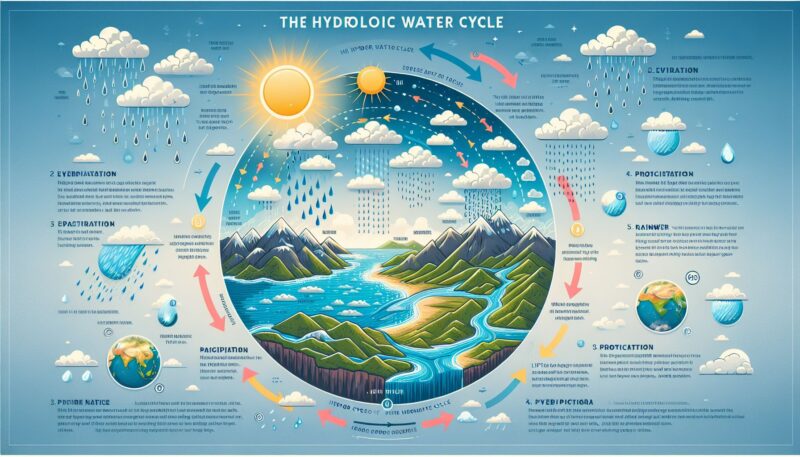
Water is the most crucial resource on our planet, sustaining life in all its forms. The hydrologic cycle, also known as the water cycle, is a continuous movement of water within the Earth’s hydrosphere, involving processes such as evaporation, transpiration, condensation, precipitation, and runoff. These intertwined processes keep ecosystems thriving, support human civilizations, and shape the Earth’s climate. In this comprehensive article, we will delve into the hydrologic cycle, explore its significance, examine the impact of human activities on it, and discuss ways to preserve this precious resource.
What is the Hydrologic Cycle?
The hydrologic cycle describes the continuous movement of water on, above, and below the surface of the Earth. This cycle can be simplified into several key processes:
- Evaporation: The transformation of water from its liquid state to vapor.
- Transpiration: The release of water vapor from plants and soil into the atmosphere.
- Condensation: The process where water vapor in the air is changed into liquid water, creating clouds.
- Precipitation: The discharge of water, in liquid or solid state, from the atmosphere to Earth’s surface.
- Infiltration: The process by which water on the ground surface enters the soil.
- Percolation: The downward movement of water through pores and other spaces in soil due to gravity.
- Runoff: Water, usually from precipitation, that flows across the land surface and into streams, rivers, and eventually oceans.
- Streamflow: The flow of water in streams and rivers.
- Baseflow: The portion of streamflow that is sustained between periods of precipitation, contributed by groundwater seeping into the riverbed.
- Groundwater: Water that fills the cracks and spaces in underground soil and rock layers.
- Aquifer: Underground layers of water-bearing permeable rock or materials from which groundwater can be extracted.
- Recharge: The process by which groundwater is replenished, often through infiltration from rain or streams.
- Discharge: The natural emergence of groundwater at the Earth’s surface, as well as the withdrawal of water from aquifers.
Why is the Hydrologic Cycle Important?
The hydrologic cycle is vital for multiple reasons:
- Supporting Life: Water is essential for all living organisms. It transports nutrients, regulates temperature, is a solvent for biochemical reactions, and is crucial for growth and reproduction.
- Regulating Climate: The cycle influences climate patterns by distributing heat around the globe through atmospheric and oceanic circulation.
- Shaping Landforms: Continuous water movement contributes to soil formation, erosion, and sediment transport, shaping landscapes.
Human Impact on the Hydrologic Cycle
Human activities have significantly altered the hydrologic cycle, causing disruption in natural processes:
- Urbanization: The construction of impermeable surfaces leads to increased runoff and decreased infiltration, altering local to global water cycles.
- Deforestation: Removing trees reduces transpiration, the water vapor released by plants, affecting precipitation patterns and climate.
- Water Extraction: Over-extracting groundwater for agriculture and drinking lowers the water table and can lead to a decrease in surface water bodies.
- Climate Change: Rising temperatures intensify the water cycle by increasing evaporation rates, altering precipitation patterns, and causing more extreme weather events.
Preserving the Hydrologic Cycle
Preserving the purity of this cycle is crucial for sustaining life and the planet’s health. Here are some strategies:
- Water Conservation: Utilizing water-saving fixtures, practicing sustainable agriculture, and reducing consumption are vital.
- Protecting Green Spaces: Preserving forests and wetlands help maintain evapotranspiration and infiltration rates, sustaining local climates.
- Pollution Prevention: Reducing the use of pollutants and improving wastewater treatment diminishes the risk of contaminating water bodies.
- Sustainable Management: Groundwater resources need to be managed sustainably to prevent over-extraction and maintain baseflow into rivers and lakes.
How Do These Processes Work?
Evaporation and Transpiration
Evaporation is a solar-powered process where water is converted into vapor and rises into the atmosphere. Transpiration occurs when plants absorb water through roots and release it as water vapor from their leaves. Combined, these processes are termed evapotranspiration and are the main drivers for moisture in the atmosphere.
Condensation and Precipitation
When water vapor rises, it cools and condenses into droplets or ice crystals that form clouds. Eventually, these droplets combine to become heavy enough to fall to the ground as precipitation, which can occur as rain, snow, sleet, or hail.
Infiltration, Percolation, and Groundwater
Once precipitation reaches the Earth’s surface, it can infiltrate the soil, percolate downward, and recharge aquifers with groundwater. This stored water can later be discharged into rivers or extracted for use by humans.
Runoff and Streamflow
Water that does not infiltrate becomes runoff, flowing into waterways. Runoff contributes to streamflow, the water that flows in rivers and streams, which eventually makes its way to lakes or oceans.
Understanding Aquifers and Groundwater Dynamics
Aquifers are essential components of the hydrologic cycle, serving as natural reservoirs for freshwater. They form in porous rock or sediment layers that can hold and transmit water, playing a crucial role in supplying water for ecosystems and human use.
Groundwater dynamics involve the balance between recharge and discharge, which must be maintained to ensure sustainable water availability. With overuse and insufficient recharge, aquifers can be depleted, leading to serious ecological and economic challenges.
Threats to the Hydrologic Cycle
Several threats, often human-induced, can disrupt the balance of the hydrologic cycle:
- Water Pollution: Chemicals, heavy metals, nutrients, pathogens, and microplastics can degrade water quality, impacting ecosystems and human health.
- Eutrophication and Algal Blooms: Excessive nutrients from agricultural runoff lead to algal blooms, which in turn deplete dissolved oxygen in water, harming aquatic life.
- Climate Change: Changes in the climate can shift precipitation patterns and increase the frequency and severity of droughts and floods.
Addressing Water Quality Concerns
Maintaining water quality is a public health imperative. Technological solutions like water treatment plants utilize coagulation, flocculation, sedimentation, filtration, and disinfection (e.g., chlorination or UV irradiation) to ensure water safety for human consumption.
The Role of Watersheds
A watershed, also known as a catchment or drainage basin, is an area of land where all the water under it or drains off of it goes into the same place. Watersheds boundary lines are defined by topographic features and play a critical role in the hydrologic cycle, as they dictate how water is collected and distributed across landscapes.
Water Distribution and Infrastructure
Modern water distribution systems include a network of reservoirs, pipes, pumps, valves, water towers, and metering systems that deliver water efficiently to homes and businesses. Leak detection and maintenance are crucial for reducing water loss and ensuring a reliable supply.
The Global Picture: Oceans to Icebergs
The Earth’s oceans are