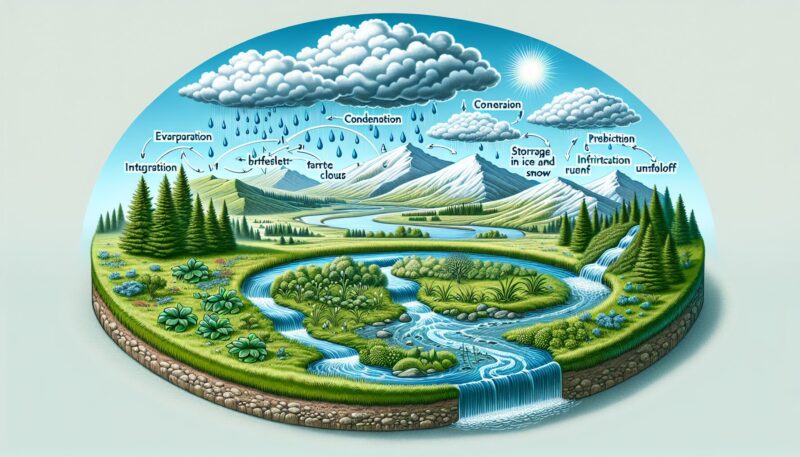
Water is the lifeblood of our planet, essential for all forms of life on Earth. It sustains ecosystems, shapes landscapes, and supports human civilizations. The continuous movement of water above, on, and below the surface of the Earth is called the hydrologic cycle, a complex system that is critical to our environmental well-being and serves as the central theme of this article. Through this exploration, we will unearth the intricacies of the hydrologic cycle, its various stages, and its profound importance.
The Stages of the Hydrologic Cycle
The hydrologic cycle, also known as the water cycle, is a continuous process propelled by solar energy. It consists of various stages, including evaporation, transpiration, condensation, precipitation, infiltration, percolation, runoff, and streamflow. Let’s delve into each of these stages in detail.
Evaporation
Evaporation is the process by which water transforms from a liquid state into a gaseous state, known as water vapor, and enters the atmosphere. Most evaporation occurs over the ocean’s surface, contributing the majority of atmospheric moisture.
Transpiration
Transpiration is the release of water vapor from plants. Through their roots, plants absorb water from the soil, which then moves up the stem and exits through the leaves’ stomata. This process not only contributes to the hydrologic cycle but also aids in cooling the plant.
Condensation
As water vapor rises and cools in the atmosphere, it begins to condense, forming small droplets on particles like dust. This is the process of condensation, and it eventually leads to the formation of clouds and fog.
Precipitation
Precipitation occurs when water droplets or ice crystals in clouds grow large enough to fall under gravity’s influence. This water returns to Earth in the form of rain, snow, sleet, or hail.
Infiltration and Percolation
Upon reaching the ground, some of the water infiltrates the soil. From there, it can move deeper underground through percolation, replenishing aquifers and contributing to groundwater flows.
Runoff and Streamflow
Not all precipitation infiltrates the soil; some of it becomes runoff, flowing over the land surface toward rivers, lakes, and oceans. As runoff collects, it contributes to streamflow, moving in recognizable channels toward larger bodies of water.
Baseflow
Baseflow is the portion of streamflow that is sustained by groundwater seeping into rivers and streams, ensuring a continuous flow even during dry periods.
The Significance of the Hydrologic Cycle
The hydrologic cycle is more than just a series of processes; it is essential for numerous reasons:
-
Water for Life: Water is fundamental to both plant and animal life. The cycle ensures that water is consistently purified and redistributed, supporting diverse ecosystems.
-
Climate Regulation: By moving heat through evaporation and condensation, the hydrologic cycle helps regulate Earth’s temperature and climate patterns.
-
Agriculture: Farmers rely on predictable precipitation and groundwater for irrigating crops, making the cycle crucial for food production.
-
Hydroelectric Power: Flowing water used to generate electricity depends on the consistent functioning of the hydrologic cycle.
-
Water Purification: Natural filtration through soil and rock layers during infiltration and percolation aids in water purification.
Challenges to the Hydrologic Cycle
Human activities and climate change exert pressure on the hydrologic cycle, altering it in ways that can lead to serious consequences:
-
Water Pollution: Contaminants from industrial, agricultural, and urban sources can disrupt the natural purification processes within the cycle.
-
Climate Change: Alterations in temperature and weather patterns can change precipitation rates and distribution, impacting water availability.
-
Overuse of Groundwater: Excessive pumping for agriculture and urban use can deplete aquifers faster than they are replenished, a process called overdrafting.
-
Deforestation: Trees play a significant role in transpiration and water retention in the soil. Deforestation can reduce these effects, leading to less moisture in the atmosphere and altered local climates.
Protection and Conservation of the Hydrologic Cycle
Protecting the integrity of the hydrologic cycle requires both policy and individual action. Conservation measures include rainwater harvesting, greywater reuse, and sustainable water supply management. Effective water legislation, such as the Clean Water Act in the United States, can regulate pollutants and manage water resources wisely.
Conclusion
The hydrologic cycle is a wonder of nature and an engine of life. Understanding its functions is crucial for preserving the delicate balance required for our ecosystems and for human existence. By taking concerted actions to protect and conserve water, we enhance the resilience of the hydrologic cycle and, by extension, the health of our planet.
Sources
-
“The Water Cycle.” U.S. Geological Survey. https://www.usgs.gov/special-topics/water-science-school/science/water-cycle
-
“Hydrologic Cycle.” National Oceanic and Atmospheric Administration. https://www.noaa.gov/education/resource-collections/freshwater/hydrologic-cycle
-
“How the Earth System Works.” Union of Concerned Scientists. https://www.ucsusa.org/resources/how-earth-system-works