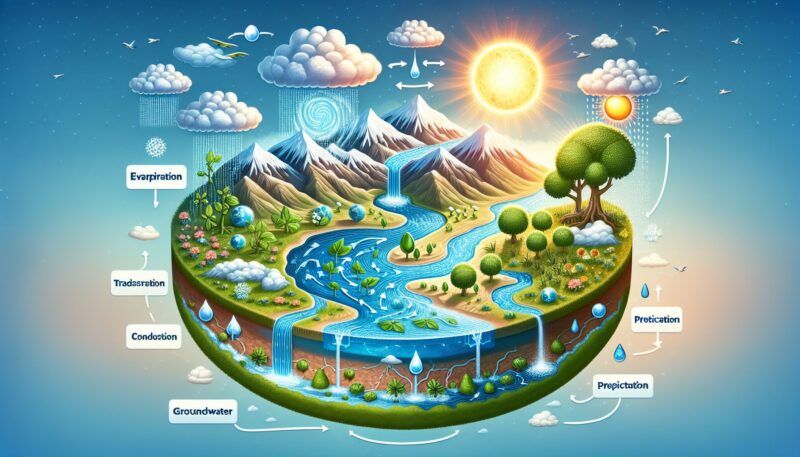
Water is the most crucial component for life on our planet. It shapes our environment, affects our climate, and is essential for all forms of life. Among the various concepts surrounding water and its movement on Earth, the hydrologic cycle, also known as the water cycle, stands as a fundamental ecological and geological process. This article aims to provide an in-depth look at the hydrologic cycle, its stages, and its importance within the broader context of Earth’s hydrosphere.
The Hydrologic Cycle – A Continuous Journey
The hydrologic cycle describes the continuous movement of water on, above, and below the surface of the Earth. The cycle keeps the Earth’s water constantly moving between the oceans, the air, the land, and back again, linking the atmosphere, land, and ocean in an intricate dance that sustains life. Let’s break down the various stages of the hydrologic cycle:
1. Evaporation
Evaporation is the process by which water changes from a liquid to a gas or vapor. As the sun heats bodies of water, like oceans, rivers, and lakes, the water temperature rises, causing its molecules to move faster and escape into the air as water vapor. Plants also contribute to evaporation through a process called transpiration, where water absorbed by roots is released through leaves.
2. Condensation
When water vapor rises into the atmosphere, it cools and turns back into liquid droplets, forming clouds. This process is known as condensation. As more vapor condenses into water droplets, clouds become heavy and can lead to precipitation.
3. Precipitation
As clouds gather more water droplets, they become heavier and eventually release moisture in various forms such as rain, sleet, snow, or hail, depending on the temperature and atmospheric conditions. This falls to the ground and is what we observe as precipitation.
4. Infiltration and Percolation
Upon reaching the ground, water can take several paths. Some of it infiltrates the soil’s surface and moves downward through percolation, seeping into underground aquifers — stores of fresh groundwater.
5. Runoff and Streamflow
Water that doesn’t infiltrate becomes runoff, flowing over the ground and collecting in puddles, streams, or rivers. Some of this water will be absorbed by plants, evaporate back into the atmosphere, or travel into oceans and other water bodies.
6. Baseflow
Baseflow is the portion of the streamflow that is sustained between precipitation events, fed by groundwater seeping into river beds and banks. It is an essential contributor to the sustained flow in rivers, especially during dry periods.
7. Groundwater Movement and Discharge
Groundwater stored in aquifers can remain underground for long periods or move through the ground and back into the water cycle through springs or discharge areas, helping to maintain river flows and ecosystems.
Importance of the Hydrologic Cycle
Understanding the importance of the hydrologic cycle is crucial for several reasons:
-
Climate Regulation: The cycle plays a key role in regulating the planet’s climate. It affects air temperature and precipitation, impacting weather patterns and climatic conditions globally.
-
Habitat Creation: Freshwater ecosystems rely on the cycle to provide and sustain suitable habitats for a wide variety of flora and fauna.
-
Water Resources Management: Knowing how the cycle works helps us to manage our water resources. It informs agricultural practices, urban planning, and our usage of freshwater for various needs such as drinking, industry, and recreation.
-
Environmental Protection: Pollution and human interventions can disrupt the natural balance of the cycle, leading to issues like eutrophication, water scarcity, and climate change. Hence, protecting the processes within the water cycle is critical for environmental conservation.
Human Impact on the Hydrologic Cycle
Human activity has significantly impacted the hydrologic cycle. Deforestation, urbanization, and industrialization have altered evaporation rates, groundwater recharge, and the flow of rivers and streams. Agriculture can influence local hydrologic cycles through irrigation, which increases evaporation and transpiration rates, often leading to waterlogging or salinization of soils and aquifers.
Pollution also plays a critical role in disrupting water quality within the hydrologic cycle. Chemicals, waste, and plastic can infiltrate the cycle at various stages, leading to contaminated groundwater, toxic runoff, and harming aquatic ecosystems.
Protecting and Managing the Hydrologic Cycle
To protect and manage the hydrologic cycle, it is essential to:
-
Implement Sustainable Water Practices: Encourage practices like rainwater harvesting and greywater reuse to reduce demand on freshwater sources.
-
Enhance Water Treatment and Pollution Control: Use advanced methods like reverse osmosis, ozonation, and UV irradiation to ensure water quality and reduce contaminants from entering the cycle.
-
Promote Watershed Management: Protect and manage the areas of land where precipitation collects and drains off into a common outlet, such as a river, bay, or other water bodies.
-
Invest in Water Conservation: Educate about reducing water usage and improving water-use efficiency in industries, agriculture, and homes.
-
Address Climate Change: Take action against climate change, which can lead to more extreme weather events, altering precipitation patterns and intensity across the globe.
Conclusion
The hydrologic cycle is a natural marvel that is essential for maintaining life on Earth. It sustains our ecosystems, regulates our climate, and supplies fresh water for all living organisms. As stewards of this planet, it is our responsibility to understand this cycle’s mechanisms and protect it from the impacts of human activity. By doing so, we can ensure that clean, accessible water will continue to nourish and sustain life for generations to come.
Sources
- “The Water Cycle.” United States Geological Survey (USGS). https://www.usgs.gov/special-topic/water-science-school/science/water-cycle
- “Global Hydrology and Climate Center.” National Aeronautics and Space Administration (NASA). https://www.nasa.gov/centers/goddard/earthandsun/hydrology.html
- “Principles of Hydrology.” United Nations Educational, Scientific and Cultural Organization (UNESCO). https://en.unesco.org/themes/water-security/hydrology/principles