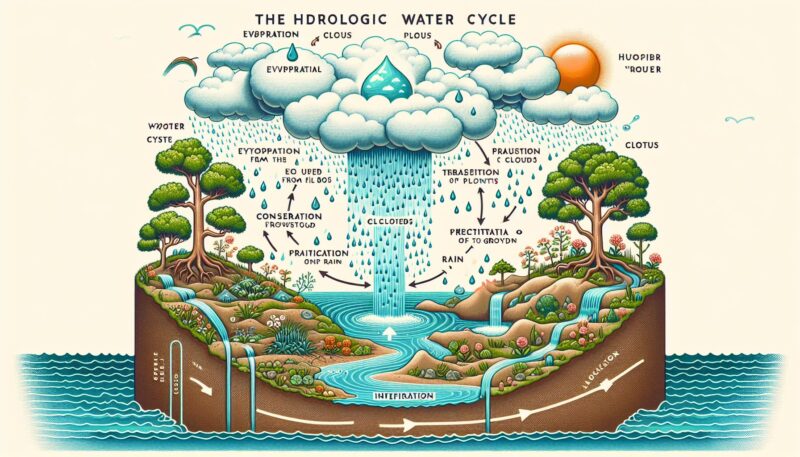
Water is the lifeblood of our planet, an essential element for all forms of life. Even though two-thirds of the Earth’s surface is covered by water, the world often faces water-related challenges due to uneven distribution, pollution, and climate change. Understanding the Hydrologic Cycle, also known as the water cycle, is critical for grasping how water moves through the environment and how we can sustainably manage this precious resource.
Introduction to the Hydrologic Cycle
The hydrologic cycle is a continuous and dynamic process that describes the movement of water above, on, and below the surface of the Earth. This cycle is crucial in maintaining life on our planet, as it circulates and conserves water in its various forms—vapor, liquid, and ice. Let’s dive deep into the processes involved in the hydrologic cycle.
The Processes of the Hydrologic Cycle
Evaporation
Evaporation is the process by which water is converted from liquid to vapor and is mainly powered by the heat from the sun. Bodies of water, such as lakes, rivers, and oceans, along with soil moisture and wet vegetation, contribute to the atmospheric moisture through evaporation.
Transpiration
Similar to evaporation, transpiration refers to the process by which water within plants is transferred to the atmosphere. Plants absorb water through their roots and eventually release some of it as vapor through tiny openings in their leaves known as stomata.
Condensation
Condensation is the opposite of evaporation. As warm, moist air rises and cools, the water vapor within it begins to condense into tiny droplets, forming clouds. This process is an essential precursor to precipitation.
Precipitation
When the water droplets within clouds get too heavy, they fall back to the surface as precipitation. This can be in the form of rain, snow, sleet, or hail, depending on the temperature and atmospheric conditions.
Infiltration and Percolation
Once precipitation reaches the ground, it can take several paths. Infiltration is the process by which water penetrates the surface of the soil. As it moves deeper into the ground, it goes through percolation, further filtering through soil and rock layers.
Runoff
Alternatively, water that does not infiltrate the soil becomes runoff, flowing on the land’s surface into nearest streams, rivers, lakes, or oceans. Runoff is an important process because it not only contributes to surface water bodies but also can carry nutrients and pollutants.
Streamflow and Baseflow
Streamflow is the movement of water in rivers and streams, primarily driven by runoff. During drier periods, rivers and streams are maintained by baseflow, which is the sustained flow contributed by groundwater seeping into these waterways.
Groundwater Movement
Some water that infiltrates the soil will join the underground stores of freshwater known as groundwater. Groundwater flows slowly through the subsurface, shaping the landscape, and emerges in springs or contributes to rivers or wetland areas.
Recharge and Discharge
Groundwater storage areas, or aquifers, are naturally replenished by the process of recharge, where water from rain and snowmelt percolates through the ground. In contrast, discharge is the natural or man-induced process of groundwater moving to the surface or being removed from an aquifer through wells.
The Importance of the Hydrologic Cycle
The hydrologic cycle has several essential functions:
- Distribution of Water: It moves water from places where it’s abundant to areas where it’s scarce.
- Climate Regulation: Water vapor is a major greenhouse gas; hence, the cycle plays a significant role in climate dynamics.
- Support Ecosystems: Aquatic ecosystems rely on the continuous movement of water to provide habitat and drive ecological processes.
- Availability for Human Use: The cycle replenishes freshwater sources which are vital for consumption, agriculture, and industry.
Human Impact on the Hydrologic Cycle
Our actions have altered the natural hydrologic cycle in several ways. The construction of dams and reservoirs, extraction of water for agricultural and industrial uses, deforestation, urbanization, and the emission of greenhouse gases affecting climate patterns, all modify the cycle’s flow and can have profound environmental consequences.
Challenges and Conservation Efforts
Water Pollution
Water pollution from agricultural runoff, industrial discharges, and other human activities is a critical issue. Contaminants affect water quality and can harm aquatic ecosystems and human health.
Water Scarcity and Climate Change
Water scarcity is a growing concern in many areas, exacerbated by climate change, which can alter precipitation patterns, leading to droughts or floods. Sustaining water availability under changing climate conditions is a significant challenge.
Water Conservation Strategies
Water conservation is crucial for ensuring sustainable water resources for future generations. Strategies such as rainwater harvesting, greywater reuse, and better management of agricultural water can help in reducing the water footprint.
Conclusion
Understanding the hydrologic cycle is imperative for managing the Earth’s water resources sustainably. Through this knowledge, we can better appreciate the intricacies and vulnerabilities of our water systems and work towards protecting them.
Sources
- United States Geological Survey. The Water Cycle. https://www.usgs.gov/special-topics/water-science-school/science/water-cycle
- NASA’s Earth Observatory. The Water Cycle. https://earthobservatory.nasa.gov/features/Water
- World Meteorological Organization. Hydrology and Water Resources Programme. https://public.wmo.int/en/our-mandate/water/hydrology