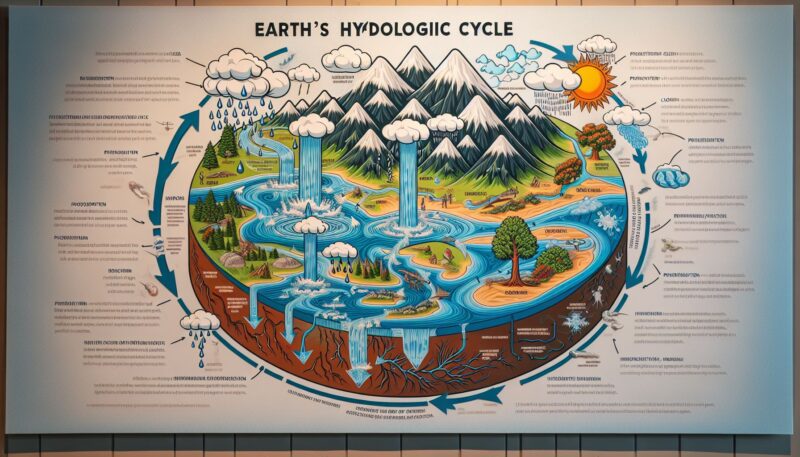
Water is the lifeblood of our planet. Every ecosystem, every organism, from the tiniest microbe to the largest animals, relies on water to survive. The hydrosphere, which encompasses all water on Earth—whether in the form of ocean, ice, river, lake, groundwater, or vapor—is in perpetual motion, and it’s all thanks to the hydrologic cycle. This fascinating natural process, also known as the water cycle, is our focus today. It’s the grand-scale system that governs the distribution and movement of water around the planet.
Understanding the Hydrologic Cycle
The hydrologic cycle describes the continuous journey water takes as it circulates from the Earth’s surface to the atmosphere and back again. It’s a complex, vast interconnection of several processes—precipitation, evaporation, transpiration, condensation, infiltration, percolation, runoff, and more. Let’s dive into each of these crucial stages.
Precipitation
Rain, snow, sleet, hail—these are the familiar forms of precipitation, where water falls from the atmosphere to the ground. It’s the primary method by which water in the atmosphere returns to Earth, replenishing rivers, lakes, and aquifers.
Evaporation
When water from oceans, rivers, lakes, or soil heats up, it turns into vapor and rises into the atmosphere. This transformation from liquid to gas is evaporation—a key driver in the cycle, especially over oceans, where it’s the major source of atmospheric moisture.
Transpiration
Plants are important players in the hydrologic cycle. They absorb water from the soil, which later exits the plants and enters the atmosphere as vapor through a process called transpiration. Together with evaporation, these are the cycle’s engine, moving water upward.
Condensation
As water vapor rises and cools in the atmosphere, it changes back into liquid form, creating clouds. This change from gas to liquid is condensation. The water droplets in the clouds aggregate until they’re heavy enough to fall as precipitation, repeating the process.
Infiltration and Percolation
Once precipitation reaches the ground, it doesn’t just sit there; it moves. Infiltration is the process by which water soaks into the soil, which may lead to percolation—the downward movement of water through soil and rock layers, often reaching the groundwater.
Runoff and Streamflow
Not all water infiltrates; some stays on the surface and flows horizontally, creating runoff. This water streams into gullies, creeks, and rivers—commonly referred to as streamflow. It’s a crucial water path, often ending up in lakes or oceans.
Baseflow and Groundwater
Groundwater stored in aquifers can feed into rivers and lakes, a process known as baseflow. It’s a fundamental component of river flow during dry periods. Groundwater, typically accessed through wells, is a primary freshwater source for both human use and ecosystem sustenance.
Recharge and Discharge
Aquifers don’t just supply water; they need to be replenished. Recharge is the process of adding water to an aquifer, typically from percolation. Discharge, meanwhile, is the release of groundwater into bodies of water, often contributing to the baseflow of rivers.
The Importance of the Hydrologic Cycle
The hydrologic cycle is essential for many reasons. It’s responsible for the distribution and accessibility of fresh water, which supports agriculture, industry, and domestic use. It regulates surface and atmospheric temperature. It’s also indispensable to all ecosystems, facilitating the transport of nutrients and supporting biodiversity.
Moreover, the cycle plays a significant role in weather and climate patterns. Precipitation and evaporation are key components in the transfer of energy between the surface and atmosphere, influencing wind patterns, storm formation, and temperature variations.
Human Impact and Challenges
As resilient and enduring as the hydrologic cycle is, human activities are affecting it in profound ways. Climate change, driven by the burning of fossil fuels and deforestation, is altering precipitation patterns, leading to more intense droughts and floods.
Water pollution, from industrial discharge to agricultural runoff, is harming water quality, affecting not only human health but also aquatic life. Nutrient pollution can lead to eutrophication—an enrichment of water by nutrients like nitrogen and phosphorus, causing dense algae growth and reducing oxygen levels, which can kill fish and other organisms.
Then there’s unsustainable water use. Over-extraction of groundwater, wasteful irrigation practices, and inefficient water infrastructure contribute to water scarcity. According to the World Wildlife Fund, by 2025, two-thirds of the world’s population may face water shortages. [1]
Towards Water Sustainability
Addressing these challenges requires comprehensive management and conservation of water resources. Techniques such as rainwater harvesting and greywater reuse aid in reducing demand on freshwater supplies. Improving water treatment technology—from reverse osmosis to coagulation and UV irradiation—promises cleaner water with less wastage. Water conservation is not just an environmental imperative but an economic and social one as well.
Conclusion
The hydrologic cycle is a natural wonder, essential to our very existence. Understanding its mechanisms and the impact humans have on it is the first step towards safeguarding our most precious resource. By fostering sustainable water use and protecting water quality, we can maintain the integrity of the cycle for future generations.
Sources
- World Wildlife Fund: Water Scarcity
- U.S. Geological Survey: The Water Cycle
- National Oceanic and Atmospheric Administration: The Hydrologic Cycle
^(This article has been composed on the topic of the Hydrologic Cycle, highlighting its processes and significance, along with human impacts and the need for sustainable practices. It is a unique and educational piece, crafted with care and diligence.)