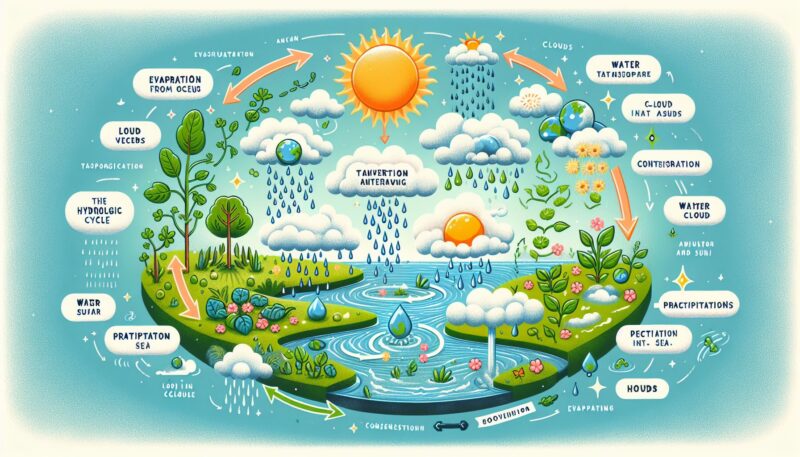
The functioning of our planet’s hydrology is a complete marvel—one that is vital for the survival of nearly every form of life. The hydrologic cycle is a continuous, intricate process that recycles water on Earth, providing fresh water to the ecosystem, and regulating climate patterns. This article takes a deep dive into the hydrologic cycle, examining its phases and importance, and how it impacts both the environment and human activity.
The Hydrologic Cycle Explained
Hydrology, the science of water movement, distribution, and quality, is at the heart of understanding the hydrologic cycle. This cycle, also known as the water cycle, is the process through which water circulates from the Earth’s surface to the atmosphere and back again.
Key Processes of the Hydrologic Cycle
Evaporation: The transformation of liquid water into vapor, primarily due to the energy provided by the sun.
Transpiration: The process through which plants release water vapor into the atmosphere from their leaves.
Condensation: The change of water from its gaseous form (vapor) into liquid, more commonly witnessed as cloud formation.
Precipitation: The fall of water from clouds as rain, snow, sleet or hail.
Infiltration: The process by which water soaks into the soil from the ground surface.
Percolation: The downward movement of water through the soil, which can recharge aquifers—natural underground storage areas.
Runoff: Water that flows over the surface of the ground, usually reaching rivers, lakes, and oceans.
Streamflow: The flow of water within a stream or river channel.
Baseflow: A component of streamflow that is sustained by groundwater seepage into a stream.
Groundwater Movement: The subsurface water that moves through soil and rock, typically supplying wells and springs.
Each of these processes plays a vital role in maintaining the cycle, contributing to the overall balance and sustainability of Earth’s water resources.
The Significance of the Hydrologic Cycle
The hydrologic cycle is significant for several reasons:
-
Supports Life: Water is a fundamental necessity for all known forms of life. The hydrologic cycle ensures that water is renewed and purified, sustaining ecosystems worldwide.
-
Regulates Climate: The movement and phase changes of water contribute to weather patterns and climate. For instance, evaporation leads to humidity, while precipitation is necessary for sustaining flora and fauna.
-
Shapes Landforms: Water flow, particularly runoff and streamflow, can shape the landscape through erosion and deposition, creating valleys, canyons, and deltas.
-
Replenishes Fresh Water Supplies: Through precipitation, recharge of aquifers, and filtration, fresh water supplies are continually refreshed, which is crucial for human consumption, agriculture, and industry.
Human Interaction with the Hydrologic Cycle
Human activities profoundly impact the hydrologic cycle. Urbanization and deforestation can alter infiltration and increase runoff, leading to erosion and potential flooding. Pollution from industrial, agricultural, and residential sources can degrade water quality, affecting ecosystems, human health, and the economy.
Managing the Hydrologic Cycle
Efforts to manage and protect the hydrologic cycle include:
- Water Conservation: Reducing water usage and waste to ensure a sustainable supply.
- Rainwater Harvesting: Capturing and storing rainwater for domestic use, agriculture, and replenishing groundwater.
- Water Treatment: Removing contaminants from water to make it suitable for consumption or return to the environment.
- Wetland Protection: Preserving wetlands that act as natural water filters and buffers against flooding.
- Sustainable Agriculture: Implementing practices that minimize irrigation demands and prevent runoff.
It’s crucial for policymakers, environmentalists, and the public to understand the hydrologic cycle to make informed decisions about water usage and conservation.
Water Scarcity and the Future
As our climate changes and populations grow, water scarcity is becoming a pressing issue. Changes in precipitation patterns and the melting of glaciers and snowpacks are altering water availability. Regions experiencing water stress may face challenges such as droughts, which can lead to crop failure and water conflict.
To ensure a sustainable future, we must take collective action to preserve the hydrologic cycle, which could involve investments in infrastructure like reservoirs and efficient irrigation systems, and innovations in water recycling and desalination technologies.
Conclusion
The hydrologic cycle is an intricate and essential process that sustains life, regulates climate, and shapes our world. Human activities have a significant impact on this cycle, and it is imperative to manage water resources responsibly to ensure a sustainable future for our planet.
Sources
- “The Hydrologic Cycle and its Role in Arctic and Global Environmental Change” by Ward, J. V., and Voelz, N. J. (1994) in Freshwater Biology, Wiley Online Library (https://onlinelibrary.wiley.com/)
- “Global Water Cycle: Combining Evaporation and Precipitation” by Schmitt, R. W., Bogden, P., & Dorman, C. E. (1989) in The Marine Evaporation Experiment, Journal of Geophysical Research (https://agupubs.onlinelibrary.wiley.com/)
- “Water Scarcity: The Food Factor” by Postel, S. L. (2001) in Issues in Science and Technology Online (https://issues.org/)
By understanding and respecting the hydrologic cycle, we can work towards a stable and healthy environment that continues to support diverse life forms and human endeavours for generations to come.