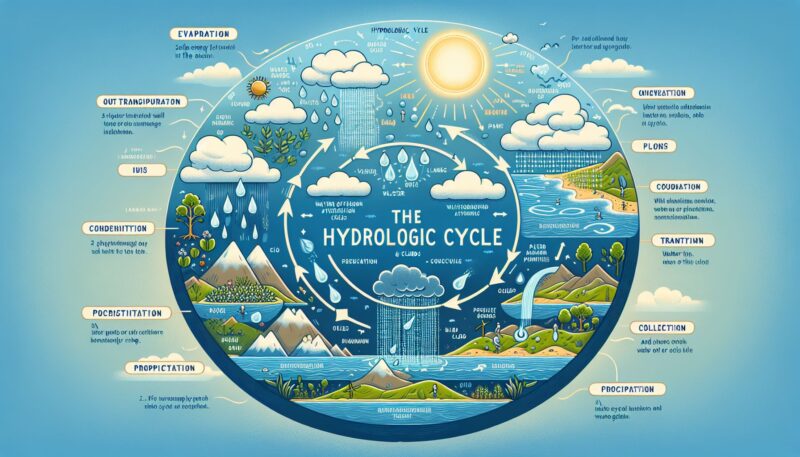
Water is the foundation of life on Earth, and its continuous movement between the atmosphere, land, and oceans – known as the hydrologic cycle – plays a critical role in sustaining ecosystems, shaping landscapes, and supporting human civilizations. This article delves into the intricacies of the hydrologic cycle, a remarkable natural process that has fascinated scientists and laypersons alike.
The Essence of the Hydrologic Cycle
The hydrologic cycle, also commonly referred to as the water cycle, describes the ceaseless circulation of water as it rises from the earth’s surface, travels through the atmosphere, and returns to the surface once more. This complex system is driven by solar energy and involves several processes, including evaporation, transpiration, condensation, precipitation, infiltration, percolation, runoff, and streamflow.
Evaporation and Transpiration: The Upward Journey
Evaporation is the process by which liquid water is transformed into water vapor, usually due to heat from the sun. This invisible vapor rises into the atmosphere, sourcing primarily from bodies of water like rivers, lakes, and oceans. However, there is also transpiration, which is the release of water vapor from plant leaves. Together, evaporation and transpiration (often combined into the term “evapotranspiration”) constitute a significant component of the upward movement of water.
Condensation: Cloud Formation and Beyond
As water vapor ascends, it cools and condenses into tiny droplets, forming clouds in the process. This transition from a gaseous to a liquid state is a key phase in the hydrologic cycle and sets the stage for precipitation.
Precipitation: The Descent of Water
Precipitation occurs when those droplets coalesce into larger ones that can no longer remain aloft. Gravity pulls them down as rain, snow, sleet, or hail. Once it hits the ground, precipitation either soaks into the soil or becomes surface runoff, eventually reaching various water bodies or re-entering the atmosphere through evaporation.
Infiltration, Percolation, and the Journey Underground
When water from precipitation permeates the soil, it’s known as infiltration. As it moves deeper, it may continue to percolate through layers of earth and rock until it replenishes groundwater in aquifers — a vital source of fresh water for ecosystems, agriculture, and human consumption.
Runoff and Streamflow: Water on the Move
Surface water that does not infiltrate the ground becomes runoff, flowing across the landscape until it reaches streams, rivers, or lakes. Streamflow describes the movement of water within these watercourses, and it can vary greatly depending on a multitude of factors, including weather, topography, and human intervention.
The Unseen Journey: Groundwater and Aquifers
Groundwater is the water found beneath the earth’s surface in soil pore spaces and within the fractures of rock formations. It forms aquifers that act as natural storage reservoirs which can be tapped for agricultural, industrial, and drinking purposes. Groundwater moves in response to gravity and pressure, eventually discharging into springs, rivers, or oceans.
The Recharge and Discharge Cycle
Aquifers are replenished by the process of recharge, where water from precipitation and runoff percolates down through soil and rock. Discharge, on the other hand, is the natural outflow of groundwater to the surface, maintaining river flows and ecosystems during periods of low precipitation.
Critical Zones: Watersheds and Catchments
A watershed, also known as a drainage basin or catchment, is an area of land where all precipitation collects and drains off into a common outlet, such as a river, bay, or other body of water. The health and sustainability of watersheds are essential for preserving biodiversity, supporting agriculture, and providing clean water.
The Vitality of Rivers, Lakes, and Wetlands
Rivers are the flowing networks of the hydrologic cycle, transporting water from headwaters to oceans. Alongside them are lakes, which may serve as reservoirs for fresh water, and wetlands, which act as natural water filters and habitats for diverse species.
Where Fresh and Saltwater Meet: Estuaries and Oceans
Estuaries, the places where rivers meet the sea, are dynamic environments where freshwater from rivers mixes with saltwater from oceans. Oceans, covering over 70% of Earth’s surface, are the principal storehouses of water and play a crucial role in regulating the global climate by absorbing heat and carbon dioxide.
The Frozen Components: Glaciers, Icebergs, and Permafrost
Not all water in the cycle is liquid. Glaciers and icebergs represent vast, solid reservoirs of freshwater, while permafrost consists of permanently frozen soil that holds additional water. These frozen components impact sea levels and, as they melt due to global warming, reveal the profound influence of the hydrologic cycle on climate change.
Monitoring Snowpack and Water Quality
Snowpack, the accumulation of winter snowfall, is an important source of spring and summer water when it melts. Water quality, meanwhile, assesses the suitability of water for various uses, affected by factors like pH, salinity, turbidity, and the presence of nutrients, pathogens, and pollutants.
The Threat of Water Pollution and Eutrophication
Water pollution, arising from contaminants like heavy metals, microplastics, and chemicals, poses a serious risk to ecosystems and human health. Eutrophication, driven by excess nutrients in water bodies, can lead to algal blooms and depleted dissolved oxygen, harming aquatic life.
Water Treatment and Distribution: Ensuring Access to Clean Water
Water treatment involves a series of processes — including coagulation, flocculation, sedimentation, filtration, and disinfection — to make water safe for consumption. Technologies like reverse osmosis and desalination are used to treat saline water, making it potable or suitable for irrigation. These treated waters are then distributed via a network of pipes, pumps, and water towers to reach consumers.
Conservation and the Future of Water
Water conservation is the careful management and use of water resources to ensure long-term sustainability. Strategies such as rainwater harvesting, greywater reuse, and reducing water footprints are growing in importance as the world confronts challenges like water scarcity, water stress, droughts, and the impacts of climate change.
Navigating Conflicts and Fostering Diplomacy
As a vital resource, water can also be a source of conflict, particularly in regions where it is scarce. Water diplomacy seeks to prevent and resolve conflicts over water resources, promoting cooperation and sustainable management across borders.
The Cycle Continues
The hydrologic cycle is a testament to the interconnectivity of natural systems. Its function impacts weather patterns, landscape formations, and the availability of water for all forms of life. Understanding and protecting this cycle is crucial, not just for sustaining ecosystems but for preserving human existence as we know it.
To explore further details about the hydrologic cycle and its components, consult the following sources:
- United States Geological Survey (USGS) – The Water Cycle: usgs.gov/special-topic/water-science-school/science/water-cycle