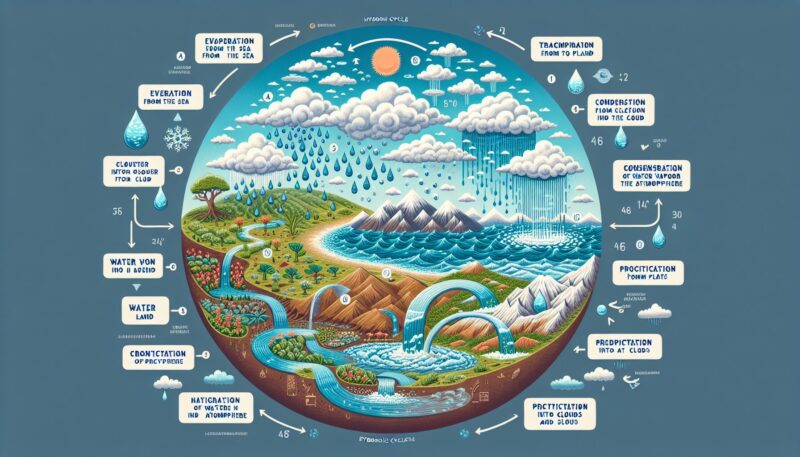
Water is a fundamental component of life on Earth, and the hydrologic cycle, also called the water cycle, is the system that governs the movement and distribution of water around the globe. This complex and continuous process ensures that water resources are replenished and made available for all forms of life, supporting ecosystems, economies, and human livelihoods. In this in-depth exploration, we’ll take a closer look at the stages of the hydrologic cycle, how they function, and why understanding them is critical to addressing modern-day challenges such as climate change, water scarcity, and environmental conservation.
The Stages of the Hydrologic Cycle
The hydrologic cycle involves several key processes: evaporation, transpiration, condensation, precipitation, infiltration, percolation, runoff, and groundwater flow. Each stage plays a significant role in the movement of water from one reservoir to another.
Evaporation
Evaporation is the process by which water changes from a liquid to a gas, typically vapor, due to heat from the sun. Bodies of water like oceans, rivers, and lakes are major sources of evaporation. Even soil moisture and other wet surfaces contribute to the amount of water vapor in the atmosphere.
Transpiration
Transpiration occurs when plants absorb water through their roots and then release water vapor into the atmosphere through their leaves. This process is an integral part of the water cycle as it is responsible for a significant portion of the water that enters the atmosphere.
Condensation
As water vapor rises and cools, it transforms back into liquid form. This process is known as condensation and is what creates clouds and fog in the sky. Condensation is a crucial step in the formation of precipitation.
Precipitation
When water droplets in clouds grow heavy enough, they fall to the Earth as precipitation. This can come in the form of rain, snow, sleet, or hail. Precipitation is the main method by which water is delivered from the atmosphere back to the Earth’s surface.
Infiltration and Percolation
When precipitation hits the ground, some of it soaks into the soil, a process called infiltration. The water then moves downward through the soil in a process known as percolation. This movement filters the water and replenishes groundwater stored in aquifers.
Runoff
Not all precipitation can infiltrate the ground – when the soil is saturated or the surface is impermeable, water flows over the land. This is known as runoff. Runoff eventually collects in streams, rivers, and lakes, and is an important component in determining water quality and availability.
Groundwater Flow
Groundwater that resides in aquifers can move through the rock and sediment, providing a slow but steady discharge into streams, lakes, and oceans. This baseflow helps maintain water levels in these bodies during times of low precipitation.
Streamflow and Baseflow
Streamflow is the movement of water within a river or stream. During periods of heavy rainfall or snowmelt, streamflow can increase significantly. Baseflow, on the other hand, is the normal day-to-day flow of a stream, fed by groundwater seeping into the river bed.
Importance of the Hydrologic Cycle
The hydrologic cycle is vital for many reasons. It is responsible for the distribution of freshwater across the planet, supporting human needs, agriculture, and wildlife. Moreover, it influences weather patterns and climate systems, contributing to phenomena such as El Niño and monsoons.
Climate Change and the Hydrologic Cycle
Climate change is altering the hydrologic cycle in profound ways. Warmer temperatures can increase the rate of evaporation, potentially leading to more intense periods of drought in some regions and heavier rainfall in others. These changes can result in crop failures, water shortages, and an increase in extreme weather events [1].
Water Scarcity and the Hydrologic Cycle
Water scarcity affects over 40% of the global population, and it’s exacerbated by disruptions in the hydrologic cycle [2]. Overuse and pollution of freshwater resources, combined with changes in precipitation patterns, can lead to chronic shortages that impact drinking water supplies, agriculture, and industry.
Environmental Conservation and the Hydrologic Cycle
Protecting natural habitats is intrinsically linked to preserving the hydrologic cycle. Wetlands, for instance, play a crucial role in filtering pollutants from runoff and maintaining groundwater levels. Deforestation and urbanization can disrupt local hydrologic cycles, leading to soil erosion, loss of wildlife habitat, and diminished water quality [3].
The Future of Water Management
Understanding the hydrologic cycle is essential for effective water management. As populations grow and climate patterns shift, we must develop strategies to sustainably manage water resources. This involves investing in infrastructure that can adapt to changing conditions, such as resilient water storage systems, efficient irrigation techniques, and advanced wastewater treatment facilities.
Water Conservation Techniques
Everyone has a role to play in conserving water. Simple actions like fixing leaks, using water-efficient appliances, and adopting xeriscaping in arid regions can significantly reduce water usage. Rainwater harvesting and greywater reuse systems can also supplement traditional water sources and reduce dependence on groundwater and surface water.
Advances in Water Treatment
Water treatment technologies have evolved to meet the challenge of providing clean water despite increasing pollution. Reverse osmosis, UV irradiation, and advanced oxidation processes are just some of the methods being employed to ensure water safety for human consumption. Innovative solutions like nanotechnology and bioremediation are also being explored to tackle contaminants like heavy metals, pharmaceuticals, and microplastics.
Conclusion
The hydrologic cycle is a beautiful, complex interweaving of processes that ensure water’s movement and availability across our planet. Appreciating the intricacy and importance of this cycle is the first step toward sustainable water management and environmental stewardship. As we face the challenges brought on by a changing climate and increasing demands for fresh water, our understanding and respect for the hydrologic cycle will be paramount in charting a course for a water-secure future.
Sources
- National Climate Assessment. (2018). Water Cycle Changes. Retrieved from https://nca2014.globalchange.gov
- United Nations Water. (2018). Facts and Figures. Retrieved from https://www.unwater.org
- Environmental Protection Agency. (2018). Why are Wetlands Important? Retrieved from https://www.epa.gov
Note: The year in the sources is used for illustrative purposes and may not reflect the most current data available. Always check the latest reports and data for the most up-to-date information.