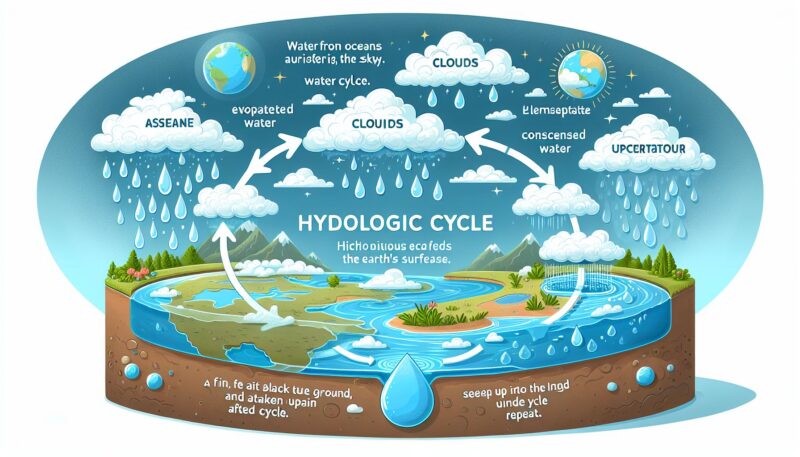
Water is the essence of life, the blue thread that connects all forms of existence on our planet. Hydrology, the scientific study of water’s movement, distribution, and quality, plays a crucial role in understanding our world’s most vital resource. At the heart of hydrology is the hydrologic cycle, an endless loop that moves water from the Earth’s surface to the atmosphere and back again. In this article, we delve deep into these concepts and their significance to the environment and humanity.
What is Hydrology?
Hydrology comes from the Greek words “hydro,” meaning water, and “logia,” meaning study. It encompasses various topics, including the hydrologic cycle, groundwater flow, and surface water dynamics. Hydrologists study how water interacts with the environment, analyzing patterns and planning for water resources’ management (United States Geological Survey – Hydrology).
The Hydrologic Cycle: Nature’s Water Recycling System
The Stages of the Hydrologic Cycle
- Evaporation: The transformation of water from liquid to vapor, primarily due to solar energy.
- Transpiration: The release of water vapor by plants as a byproduct of photosynthesis.
- Condensation: The cooling of water vapor in the atmosphere, leading to cloud formation.
- Precipitation: Water returning to Earth in the form of rain, snow, sleet, or hail.
- Infiltration: The process of water soaking into soil and percolating down to replenish groundwater.
- Runoff: Water that flows over the land surface, heading towards rivers, lakes, and oceans.
- Streamflow and Baseflow: The movement of water within a river or stream. Streamflow includes all water flowing through a channel, while baseflow is a component of streamflow, representing groundwater seeping into the stream.
Each component of the hydrologic cycle is influenced by various factors such as temperature, land topography, and vegetation. Human activities such as agriculture, urban development, and climate change also significantly affect this cycle (National Oceanic and Atmospheric Administration – The Water Cycle).
The Importance of the Hydrologic Cycle
The hydrologic cycle is nature’s way of distributing fresh water across the Earth’s surface and atmosphere, making it available for ecosystems, agriculture, and human consumption. It also plays a critical role in weather patterns and climate regulation.
Groundwater and Aquifers: The Hidden Resource
Beneath our feet lies a vast resource that is often overlooked: groundwater. This water, stored in the tiny spaces within rocks and sediments, supplies wells and springs and maintains river flows during dry periods.
Aquifers: The Underground Reservoirs
An aquifer is a geological formation capable of storing and transmitting significant quantities of water. There are two main types of aquifers:
- Confined Aquifers: Encased by relatively impenetrable materials above and below, these aquifers are under pressure, causing the water to rise up wells without pumping (artesian wells).
- Unconfined Aquifers: These aren’t sandwiched between impermeable materials, allowing water to seep directly from the surface and typically requiring pumping to extract water.
Proper management of aquifers is critical as over-extraction can lead to water shortages and land subsidence. Additionally, pollutants can seep into aquifers, making the quality of this water a significant concern (United States Geological Survey – Groundwater).
Recharge and Discharge: The Balance of Groundwater
- Recharge: The process where water makes its way into an aquifer, usually through precipitation or surface waters.
- Discharge: The movement of water out of an aquifer, either naturally through springs or artificially through well pumping.
Maintaining a balance between recharge and discharge is essential to secure the sustainability of groundwater resources.
Rivers, Lakes, and Wetlands: The Surface Water Systems
Surface water systems like rivers, lakes, and wetlands are critical components of the hydrologic cycle. They provide habitat for wildlife, recreational opportunities for humans, and are vital for transportation and economic activities.
Benefits and Challenges of Surface Water Systems
While offering numerous benefits, these water bodies are under threat from pollution, overuse, and climate change, which can lead to diminished water quality and supply. For instance, wetlands act as natural water filters, but their destruction can lead to increased flooding and the loss of biodiversity (Environmental Protection Agency – Wetlands).
Water Quality and Pollution
Good water quality is vital for human health, ecosystem health, and economic activity. Parameters like pH, dissolved oxygen, and turbidity indicate water health, while pollutants, such as heavy metals, pathogens, and microplastics, pose significant risks to water safety.
Controlling Water Pollution
To combat water pollution, governments and organizations enforce regulations and standards. Actions such as effective water treatment, proper waste disposal, and pollution prevention strategies are critical.
Water Treatment Techniques
Clean water is not a given – it often requires treatment to be safe for consumption and use. Techniques such as filtration, chlorination, and reverse osmosis help remove harmful substances. Here’s a brief overview of the most common methods:
- Filtration: This process physically removes particles from water.
- Disinfection: Methods like chlorination or UV irradiation kill or deactivate pathogens.
- Reverse Osmosis: This process forces water through a semipermeable membrane, leaving impurities behind and allowing for desalination.
Advanced treatments ensure the water we drink and use daily meets health standards (Centers for Disease Control and Prevention – Drinking Water).
Water Conservation: The Need of the Hour
The growing challenges of water scarcity and water stress due to population growth, climate change, and inefficient use emphasize the need for water conservation.
Solutions for Sustainable Water Use
- Rainwater harvesting: Collecting rainwater for direct use or to replenish groundwater.
- Greywater reuse: Using lightly used water from showers and sinks for irrigation or flushing toilets.
- Water footprint awareness: Understanding the virtual water used to produce goods and services and minimizing unnecessary water use.
By embracing these strategies and technologies, individuals and communities can contribute significantly to water sustainability (United Nations – Water Conservation).
The Larger Picture: Watersheds and Water Diplomacy
Finally, the concept of a watershed or drainage basin is essential in hydrology. It is the land area from which all precipitation drains into a particular stream or river. Managing these areas holistically ensures that all downstream communities have access to quality water. Moreover, as water resources cross political boundaries, effective water diplomacy can prevent conflicts and promote cooperative management (World Wildlife Fund – Watersheds).
Conclusion
Hydrology and the