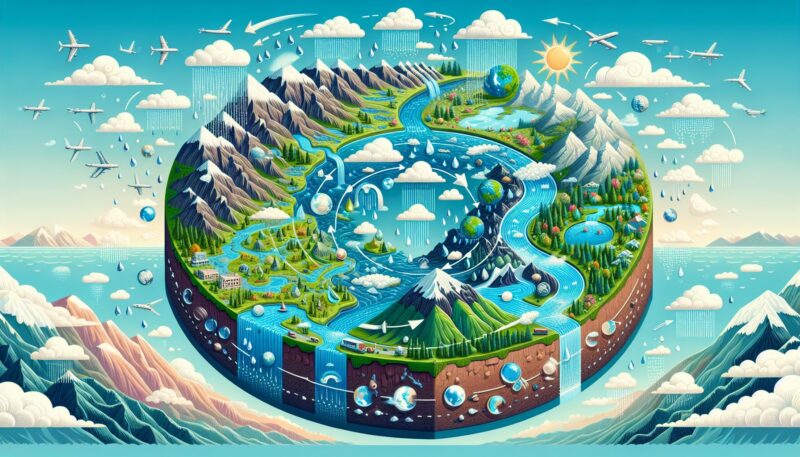
Water is the lifeblood of our planet, intricately woven into every aspect of the environment and human existence. At the heart of Earth’s water existence is the hydrologic cycle, an awe-inspiring journey that sustains life, sculpts landscapes, and regulates our climate. In this in-depth exploration, we will unravel the complexities of the hydrologic cycle, examining each stage with the meticulous care it deserves, and understanding its role in the grander scheme of Earth’s hydrosphere.
Understanding the Hydrologic Cycle
The hydrologic cycle, also known as the water cycle, is a continuous movement of water on, above, and below the surface of the Earth. This cycle is the natural process that recycles Earth’s water supply, which involves the evaporation of water from the surface, its transport through the atmosphere, precipitation back to the surface, and the return to the ocean via surface and groundwater flows.
The Stages of the Hydrologic Cycle
Evaporation
Solar energy heats the surface of the planet, causing water from oceans, rivers, lakes, and even soil moisture to transform from liquid to vapor—a process known as evaporation. Plants also contribute through transpiration, releasing water vapor from their leaves. Together, evaporation and transpiration are often referred to as “evapotranspiration.”
Condensation
As water vapor rises and cools in the atmosphere, it changes back into liquid droplets. This process, called condensation, is what forms clouds and fog. Temperature is a vital factor here, with colder air holding less moisture, leading to condensation.
Precipitation
When these droplets combine and grow heavy enough, they fall back to Earth as precipitation—in the form of rain, snow, sleet, or hail—completing a vital portion of the cycle. The type of precipitation that occurs depends on temperature conditions in the atmosphere and at the Earth’s surface.
Infiltration and Percolation
Once precipitation reaches the ground, the water doesn’t merely rest; it continues its journey. It seeps into the soil through infiltration and moves downward through percolation, replenishing aquifers—natural storage areas in the ground.
Runoff and Streamflow
Excess water that does not infiltrate becomes runoff, traveling over land and eventually flowing into streams, rivers, and other bodies of water. This movement, known as streamflow, is an essential component of the hydrologic cycle, as it is the main method by which water is transported from land to sea.
Baseflow and Groundwater
Groundwater, which comprises baseflow, steadily seeps into rivers and streams, contributing to their flow during dry periods. This interaction between surface water and groundwater is a key aspect of the hydrologic balance.
Return to the Oceans
Finally, the water reaching rivers and streams makes its way back to the oceans, where it will again be subject to evaporation, thus perpetuating the hydrologic cycle.
The Hydrosphere: A Broader Perspective
The water cycle is a fundamental element of the broader hydrosphere, which includes all water found on, above, and below the surface of the Earth. The hydrosphere interacts with the atmosphere, biosphere, and geosphere, influencing weather patterns, climate, topography, and life in countless ways.
The Importance of Water
Without water, life as we know it would not exist. From the cellular processes that define living organisms to the grandest ecosystems, water is a driving force behind survival and biodiversity.
Human Impact on the Hydrologic Cycle
Human activities are also deeply intertwined with the hydrologic cycle. Through the construction of dams, irrigation practices, deforestation, and pollution, we are altering natural processes, sometimes with significant detrimental impacts on water quality and availability.
Climate Change and the Hydrologic Cycle
Climate change significantly impacts the water cycle, altering precipitation patterns, intensifying evaporation, and affecting the dynamics of ice, snow, and permafrost. As a warming climate modifies sea surface temperatures, the distribution and intensity of rainfall and snowfall are affected, which can lead to increased occurrences of droughts and floods.
Mitigating Human Impacts
To mitigate our effect on the hydrologic cycle, measures such as sustainable water management, conservation, and policy interventions are increasingly important. Solutions like rainwater harvesting, greywater reuse, and improving water-use efficiency can lessen our water footprint and ensure that this precious resource is used more wisely.
The Significance of Each Drop
In the grand scheme, each phase of the hydrologic cycle is a crucial cog in the machine that drives Earth’s water distribution. From a single drop of rain falling on the soil to vast oceanic movements, every component is essential to maintaining the balance within this incredible natural system.
Conclusion
The hydrologic cycle is the fundamental environmental process that recycles Earth’s water resources. Its impact ranges from the smallest organisms to global weather systems. As stewards of this planet, understanding and respecting this complex cycle is critical.
Sources:
- “The Water Cycle.” United States Geological Survey (USGS). https://www.usgs.gov/special-topic/water-science-school/science/water-cycle
- “Hydrosphere.” The Encyclopædia Britannica. https://www.britannica.com/science/hydrosphere
- “Climate Change: How Do We Know?” The National Aeronautics and Space Administration (NASA). https://climate.nasa.gov/evidence/
By diving into the wondrous intricacies of the hydrologic cycle, we gain a profound appreciation for the phenomenal processes at work. It is only through awareness and actionable knowledge that humanity can genuinely stride towards harmonious coexistence with the natural world’s life-giving cycles.