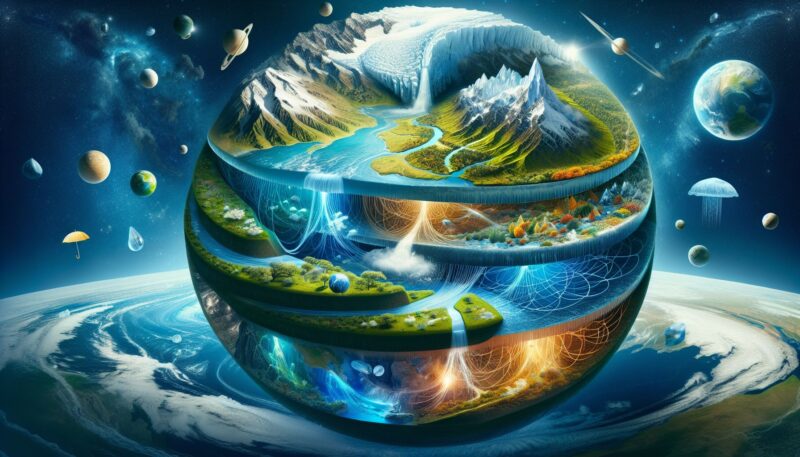
The hydrosphere is a dynamic and vast part of the Earth, encompassing all the water on the planet’s surface, in the atmosphere, and in the ground. It includes all the oceans, seas, rivers, lakes, glaciers, and underground aquifers, as well as water vapor and even the ice caps on the poles. This interconnected system plays a critical role in Earth’s climate, supports a myriad of ecosystems, and is essential for all known forms of life.
What is the Hydrosphere?
At its core, the hydrosphere is the total sum of Earth’s water, whether it be solid, liquid, or gas. It covers about 71% of Earth’s surface, mostly in the form of oceans which account for about 96.5% of all Earth’s water. Freshwater systems, including rivers, lakes, and groundwater, make up a much smaller fraction, yet they are of immense importance to the biodiversity and human needs.
Understanding the hydrosphere requires an insight into a variety of its components and processes, which are all interconnected through the hydrologic cycle. The hydrologic cycle, also known as the water cycle, is a continuous process that describes the movement of water above, on, and below the surface of the Earth.
The Hydrologic Cycle: Nature’s Water Recycling System
The hydrologic cycle is the engine that drives the hydrosphere and involves several key processes:
- Evaporation: The transformation of water from liquid to vapor, primarily from the surfaces of bodies of water and soil.
- Transpiration: Similar to evaporation, transpiration occurs when plants release water vapor into the air from their leaves, stems, and flowers.
- Condensation: As water vapor rises, it cools and changes back into liquid droplets, which can form clouds and eventually, precipitation.
- Precipitation: When water returns to the Earth’s surface in the form of rain, snow, sleet, or hail.
- Infiltration: The process where water soaks into the soil from the ground surface.
- Percolation: The movement of water through the soil, which replenishes aquifers and groundwater.
- Runoff: Water that flows over the surface of the land, eventually reaching rivers, lakes, and oceans.
- Streamflow: The flow of water within a river or stream, part of the surface water system.
- Baseflow: The part of a river’s flow that is sustained by seeping groundwater.
- Groundwater: Water found in the pores and cracks in underground soil and rock layers.
This cycle is essential for distributing water across different parts of the hydrosphere, making it an integral part of global climate patterns, ecosystems, and human livelihoods.
Rivers, Lakes, and Wetlands: Lifelines of the Landscape
Rivers, lakes, and wetlands are key features of the hydrosphere’s freshwater component. These bodies of water serve as habitats for countless species of plants and animals and offer vital resources for agriculture, industry, and recreation.
Rivers
Rivers are dynamic systems that carry water and nutrients from headwaters, often in mountains or hills, to larger bodies of water like lakes, seas, or oceans. They are crucial for irrigation, providing drinking water, and as transportation routes.
Lakes
Lakes are contained bodies of water that can be formed through tectonic activities, glaciation, or even volcanic craters. They act as reservoirs for freshwater and help regulate the flow of river systems.
Wetlands
Wetlands, including swamps, marshes, and bogs, are areas where the ground is saturated with water either permanently or seasonally. They are among the most productive ecosystems on Earth, acting as giant filters that trap pollutants and store carbon, thus reducing greenhouse gases.
Groundwater and Aquifers: The Hidden Resource
Beneath our feet lies another significant component of the hydrosphere – groundwater, which occupies the subsurface in soil pore spaces and in the fractures of rock formations. Groundwater is a critical source of water for drinking, irrigation, and industry. It is stored in and moves slowly through layers of soil, sand, and rocks called aquifers.
Recharge and Discharge
Groundwater systems are replenished or recharged by precipitation and by water from lakes and rivers that percolate through the ground. The water is discharged from aquifers back to the Earth’s surface via springs or can seep into lakes and the ocean.
Watersheds and Catchments
A watershed or catchment is an area of land where all the precipitation that falls eventually flows to a common outlet, such as a river, bay, or lake. Watersheds are critical for collecting and storing freshwater and can vary greatly in size and complexity.
Oceans: The Planet’s Largest Habitat
The oceans are the largest and deepest component of the hydrosphere, covering more than two-thirds of the Earth’s surface. They regulate temperature, drive weather patterns, and support a wealth of biodiversity.
Estuaries
Where the river meets the sea, estuaries form unique ecosystems that are partially enclosed by land but have open access to the ocean. These brackish water habitats support diverse species and serve as nurseries for many marine organisms.
Glaciers and Icebergs
In colder regions, freshwater is stored in large masses of ice known as glaciers. When chunks of glaciers break off, they become icebergs that float in the ocean. These frozen reservoirs are an essential part of the global water supply but are threatened by climate change.
Permafrost and Snowpack
Permafrost is permanently frozen ground found in polar regions, while snowpack refers to the accumulation of snow over time, especially in mountainous regions. Both of these contribute to the freshwater resources when they melt.
Water Quality and Pollution: Challenges for the Hydrosphere
The quality of water within the hydrosphere is essential for health, ecosystems, and economies. However, water pollution has become a pervasive problem. Nutrient runoff can lead to eutrophication, which causes excessive plant growth and decay, leading to depleted oxygen levels in the water. This can result in dead zones where marine life cannot survive.
Similarly, toxic substances like heavy metals, pathogens, and microplastics can have devastating effects on aquatic ecosystems and human health. Measuring and managing water quality involve parameters such as dissolved oxygen, turbidity, pH, salinity, hardness, and alkalinity.
Strategies for Water Management
Water treatment processes like desalination, reverse osmosis, and filtration work to provide clean water for human use. Other techniques, including disinfection through chlorination, ozonation, and UV irradiation, are used to ensure the water is free from harmful pathogens. Additionally, processes like coagulation, flocculation, and sedimentation remove solids and contaminants from water.
For sustainable water management, rainwater harvesting, greywater reuse, and innovative water conservation techniques are becoming increasingly critical, especially as water scarcity and water stress affect more regions due to climate change and population growth.
Conclusion
The hydrosphere is an interconnected, dynamic system that sustains life on Earth. From the smallest