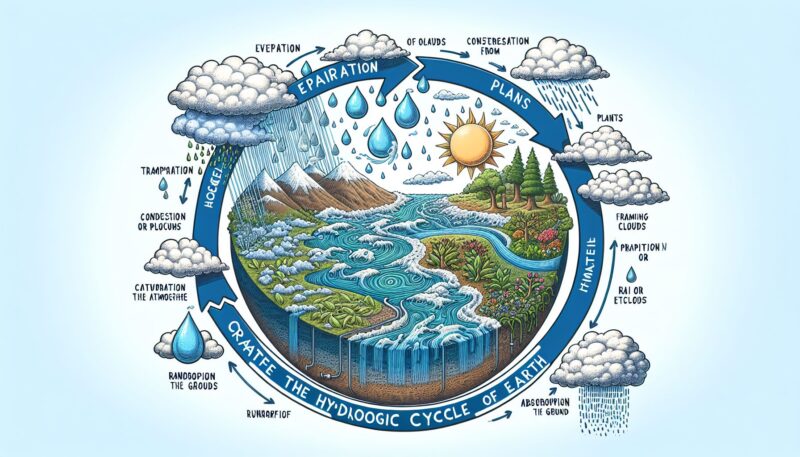
Water is the lifeblood of our planet, an essential element for the survival of all living organisms. It shapes landscapes, regulates climate, and is the main component in a vast array of biological processes. The perpetual movement and transformation of water within the Earth’s atmosphere, surface, and underground layers constitute what is known as the Hydrologic Cycle. This cycle is a complex system of continuous flow, driven by the energy from the sun, and governed by the laws of physics. This article delves into the workings of the Hydrologic Cycle, exploring each stage and its significance in sustaining life and the environment.
Understanding the Hydrology and Hydrosphere
Before unraveling the hydrologic cycle, it’s pivotal to comprehend the broader concepts of hydrology and the hydrosphere. Hydrology is the scientific study of the movement, distribution, and quality of water on Earth, including the hydrologic cycle, water resources, and environmental watershed sustainability (United States Geological Survey (USGS) – Water Science School). The hydrosphere, on the other hand, encompasses all of the water on Earth – in oceans, glaciers, lakes, rivers, underground, and in the atmosphere.
The Hydrologic Cycle: An Overview
The Hydrologic Cycle, also known as the water cycle, is a never-ending global process of water circulation from clouds to land, to the ocean, and back to the clouds. It consists of several key components: Precipitation, Evaporation, Transpiration, Condensation, Infiltration, Percolation, Runoff, and Streamflow that all work together to move and transform water throughout the environment.
Precipitation
Precipitation is the process by which water vapor in the atmosphere condenses into droplets and falls to the Earth’s surface in various forms—rain, snow, sleet, or hail. Precipitation is the primary mechanism for transporting water from the atmosphere back to the Earth’s surface, replenishing rivers, lakes, and the water stored in soil and groundwater (National Oceanic and Atmospheric Administration (NOAA)).
Evaporation and Transpiration
Evaporation is the process by which water molecules escape from a liquid state into the atmosphere as a gas, primarily driven by heat from the sun. Transpiration, often considered in conjunction with evaporation, is the release of water vapor from plants and vegetation into the air. The combination of both processes is referred to as evapotranspiration.
Condensation
Condensation is the process where water vapor in the air is changed into liquid water. It is critical in the formation of clouds, fog, and dew, which are necessary precursors for precipitation to occur. When air containing water vapor cools down to its dew point and encounters a condensation nucleus, condensation happens.
Infiltration and Percolation
After precipitation, some of the water soaks into the ground through the process of infiltration. Water then moves vertically through soil and rock layers in a process known as percolation, eventually replenishing aquifers, which are underground reservoirs of fresh water.
Runoff and Streamflow
Water that does not infiltrate the ground becomes runoff, flowing over the surface towards rivers, lakes, and oceans. This movement is called streamflow. Runoff can originate from rainfall and snowmelt, and its path can be affected by a variety of factors, including land slope, vegetation, and soil composition.
Groundwater Movement: Baseflow, Aquifers, Recharge, and Discharge
Groundwater is the water found beneath the Earth’s surface, which fills the pores within rocks and sediments. Aquifers are geological formations that can store and transmit significant quantities of groundwater. The natural refilling of water in an aquifer is called recharge, while discharge happens when water is released from the groundwater into rivers or other bodies of surface water, contributing to baseflow—a portion of streamflow that is sustained between precipitation events.
The Significance of the Watershed
A watershed—also known as a drainage basin or catchment—is a land area where all the water under it or draining off of it goes into the same place. Watersheds are essential in the hydrologic cycle as they channel precipitation into common outlets like rivers, lakes, and aquifers (United States Environmental Protection Agency (EPA)).
Impact on Ecosystems: Wetlands, Estuaries, and Oceans
Wetlands
Wetlands are ecosystems saturated with water, either permanently or seasonally, creating a unique environment that supports a diverse range of plant and animal life. They play a critical role in the hydrologic cycle by filtering pollutants, regulating water levels, and providing habitats.
Estuaries
Estuaries are dynamic environments where freshwater from rivers and streams meets and mixes with saltwater from the ocean. This mix of fresh- and saltwater creates a diverse ecosystem that serves as a nursery for many marine species.
Oceans
The world’s oceans are integral to the hydrologic cycle. Oceans store vast amounts of Earth’s water, receive runoff from land, and contribute to the water vapor in the atmosphere through evaporation—a process that is significant for climate regulation.
The Influence of Ice: Glaciers, Icebergs, and Permafrost
Glaciers, large masses of ice on land, and icebergs, floating pieces of ice, are significant freshwater reservoirs. The melting of these ice formations contributes to the global water cycle and sea-level rise. Permafrost—ground that remains frozen for two or more consecutive years—also plays a part in the cycle, as its melting can release ancient water into the environment.
Water Quality: Ensuring Sustainability and Health
Water quality is crucial for ecological health and human usage. Water pollution, from numerous sources, including eutrophication and algal blooms, threatens the health of aquatic ecosystems. Factors such as dissolved oxygen, turbidity, pH, salinity, hardness, alkalinity, heavy metals, and nutrients are critical indicators of water quality. Pathogens and emerging contaminants like microplastics also present significant challenges to maintaining clean water.
Techniques in Water Treatment
Human intervention has developed processes to treat water, ensuring it is safe for consumption and other uses. Desalination, reverse osmosis, filtration, disinfection (including chlorination, ozonation, and UV irradiation), coagulation, flocculation, and sedimentation are critical treatment processes. Other techniques like adsorption and ion exchange help remove specific contaminants from water.