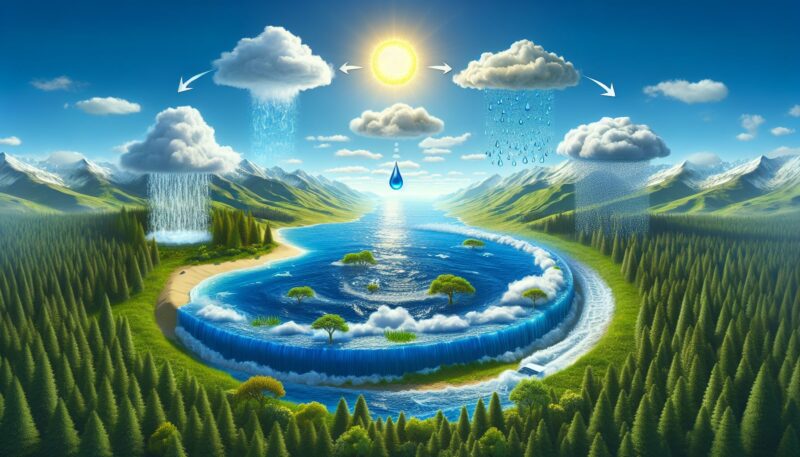
Water is the most critical component of life on Earth—an elixir without which the tapestry of life would remain threadbare and incomplete. From the sprawling oceans to the boundless skies, water exists across various stages in a continuous cycle known as the hydrologic cycle. It involves processes that are fundamental to the earth’s climate, ecosystems, and human civilizations. In this article, we delve into the intricacies of this life-sustaining cycle, examining its phases, impacts, and the increasing challenges it’s facing due to human intervention and climate change.
The Hydrologic Cycle: Earth’s Circulatory System
The hydrologic cycle is often compared to the Earth’s circulatory system. It’s the unending flow and storage of water between the atmosphere, land, and oceans. Let’s break down the stages to understand how they contribute to this dynamic system.
Evaporation: The Beginning of the Journey
The sun’s energy heats bodies of water, primarily oceans, causing water to evaporate and ascend into the atmosphere as water vapor. This invisible process is the primary engine that fuels the cycle.
Transpiration: Nature’s Respiration
Plants also contribute to the cycle through transpiration, where water absorbed by roots is eventually released into the atmosphere from their leaves and stems. Collectively, evaporation from the surface and transpiration from plants is referred to as evapotranspiration.
Condensation: Clouds Taking Shape
As water vapor rises, it cools and condenses into clouds. Air currents often carry these clouds across vast distances. The transition from gaseous to liquid or solid state forms the basis of precipitation.
Precipitation: Return to Earth
When the cloud particles become too heavy to stay afloat, they fall back to the Earth in the form of rain, snow, hail, or sleet. Precipitation is the primary mechanism for distributing fresh water across the planet’s surface.
Infiltration and Percolation: The Earth’s Thirst
Once water reaches the ground, gravity pulls some of it down into the soil—a process known as infiltration. Infiltration replenishes aquifers—natural underground storage areas. The downward movement of water through soil and rock layers is called percolation.
Runoff: Rivulets to Rivers
Not all water infiltrates. Some forms runoff, flowing on the surface toward lower elevations, ultimately reaching rivers, lakes, or oceans. Runoff is a vital source of fresh water, but it can also carry pollutants from the land into aquatic systems.
Streamflow and Baseflow: Steady Streams and Groundwater Contributions
Streamflow is the movement of water within a river or stream, driven by gravity. During drier periods, groundwater feeds into these waterways, maintaining flow—a process referred to as baseflow.
Groundwater: The Unseen Reservoir
Groundwater constitutes a significant portion of the Earth’s fresh water. It exists in aquifers and can remain trapped underground for centuries, providing a critical water supply during times of drought.
Recharge and Discharge: The Cycle’s Pulse
Groundwater recharge occurs when water from precipitation and runoff percolates down to aquifers. Discharge is the process where groundwater emerges at the surface, replenishing lakes, rivers, and wetlands.
The Connection with Climate and Weather
The hydrologic cycle is a key driver of weather patterns and climatic conditions. For instance, evaporation and transpiration add humidity to the air, influencing rainfall patterns. In their turn, precipitation and temperature determine the intensity and distribution of the hydrologic processes.
Human Impacts on the Hydrologic Desalination
Human activities have significantly altered the natural flow of the hydrologic cycle. Urbanization, agriculture, deforestation, and climate change disrupt the balance of water movement between the various stages, with potentially dire consequences.
Water Pollution: Tainting the Lifeblood
Industrial waste, agricultural runoff, and other pollutants contaminate water, threatening ecosystems and human health. Nutrient runoffs can lead to eutrophication, causing algal blooms that deplete oxygen in water and harm aquatic life.
Water Scarcity: When the Well Runs Dry
Over-extraction of groundwater, combined with prolonged droughts, has led to water scarcity in many regions. As the population grows and the demand for water increases, managing this finite resource becomes increasingly critical.
Addressing the Challenges: Sustainability and Conservation
To address the challenges facing our water resources, sustainable management practices are essential. Water conservation methods, such as rainwater harvesting and greywater reuse, can help mitigate the impact of human activities.
Innovative Solutions: Purifying and Conserving Water
Technological advancements have led to improved water treatment methods, such as reverse osmosis and UV irradiation, ensuring clean water supplies. Meanwhile, strategies like desalination are turning seawater into a viable resource for regions experiencing water scarcity.
Conclusion
The hydrologic cycle is the heartbeat of our planet’s water system. It maintains a delicate balance that supports life in all its forms. However, this balance is increasingly threatened by human activities. It is imperative that we recognize the value of this incredible cycle and work diligently to protect and sustain it to ensure a viable future for all.