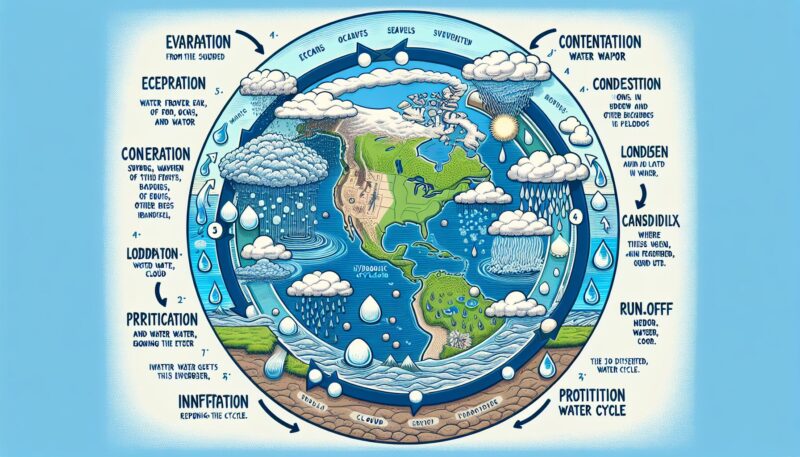
Water is the lifeblood of our planet, and the hydrologic cycle, also known as the water cycle, is the system that circulates it. This continuous process involves the movement of water from the earth to the atmosphere and back again. It is a complex system that sustains all forms of life, shapes our planet’s weather and climate, and influences natural habitats and human societies. In this article, we will explore the stages of the hydrologic cycle, their significance, and the factors affecting this endless loop that interconnects all water bodies on Earth.
What is the Hydrologic Cycle?
The hydrologic cycle describes the continuous movement of water above, on, and below the surface of the Earth. This cycle is critical to the existence of life as it plays a vital role in regulating climate, transporting nutrients, and purifying water. It’s powered by the sun’s energy and driven by the forces of gravity and temperature.
The stages of the water cycle are as follows:
- Evaporation – Conversion of water from liquid to vapor
- Transpiration – Release of water vapor by plants
- Sublimation – Transition of water from a solid to a gas, skipping the liquid phase
- Condensation – Water vapor turning into liquid or solid state (cloud formation)
- Precipitation – Water released from clouds as rain, snow, sleet, or hail
- Infiltration – Water soaking into the soil
- Percolation – Water seeping downward through soil and rock layers
- Runoff – Water that flows over land’s surface to bodies of water
- Streamflow/Baseflow – Water that flows in streams and rivers
- Groundwater movement – Water moving in aquifers beneath the Earth’s surface
Each of these stages are integral to the balance of ecosystems, and alterations in one part of the cycle can influence the whole system.
Evaporation: The Invisible Engine of the Cycle
When we think of water movement, we often picture rivers and rainfall, yet it’s the invisible process of evaporation that is the powerhouse of the hydrologic cycle.
Evaporation and Energy
- Water absorbs heat from the sun, which gives the molecules enough energy to escape the liquid state and become water vapor.
- Large bodies of water, like oceans, seas, lakes, and rivers, are the main sources for evaporation.
- About 85% of global evaporation occurs from the oceans, contributing to the vast majority of precipitation on Earth. [1]
Factors Affecting Evaporation
- Temperature: Warmer conditions increase evaporation rates.
- Surface area: Larger areas expose more water to evaporative processes.
- Wind: Higher wind speeds can enhance evaporation by moving air saturated with water vapor away from the water surface.
Transpiration: The Unseen Contribution of Plants
Transpiration is the process by which plants emit water vapor through their leaves.
Plants as Miniature Pumps
- Through root systems, plants absorb water from the soil and transport it to their leaves.
- During photosynthesis, this water is released as vapor into the atmosphere.
Sublimation: The Direct Route
Despite being less common, sublimation is another process in the hydrologic cycle, primarily in polar regions and high altitudes.
Snow and Ice Without Melting
- Sublimation causes snow or ice to vaporize without first becoming liquid.
- This phenomenon typically occurs in areas where temperatures are too low for melting but intense sunlight can still provide enough energy for sublimation.
Condensation: The Birth of Clouds
Condensation is key to cloud formation and occurs when water vapor cools and transforms into liquid or ice.
From Vapor to Droplets
- When warm air rises, it expands and cools, and the cooler temperatures cause water vapor to condense into tiny droplets or ice crystals.
- These droplets can form clouds, which can eventually lead to precipitation.