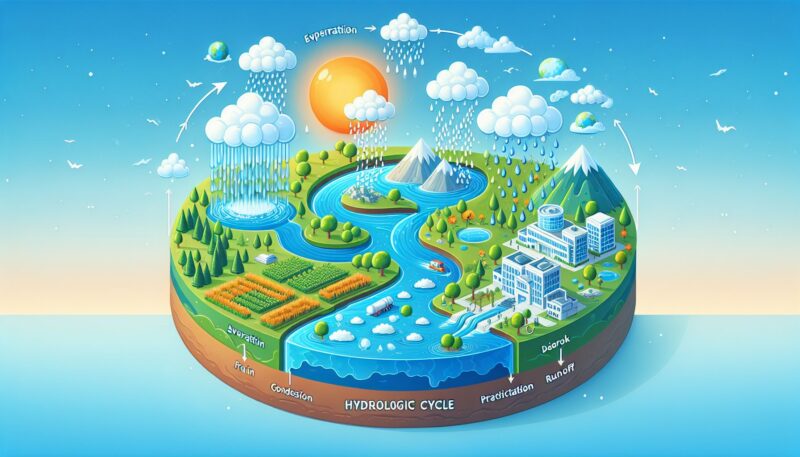

Water remains the lifeblood of existence on Earth, an element so crucial that its cycle through our planet’s various spheres underpins countless ecological processes. The hydrologic cycle, a continuous global phenomenon, portrays an intricate interplay of processes which replenish and distribute Earth’s water resources. This cornerstone of hydrology captivates scientists and environmentalists alike. Understanding this cycle is fundamental in grappling with issues such as water scarcity, climate change, and ecosystem preservation. Let’s embark on a journey to unravel the complexity and significance of the hydrologic cycle.
What is the Hydrologic Cycle?
The hydrologic cycle, also known as the water cycle, describes the continuous movement of water on, above, and below the surface of the Earth. This process is powered by the sun’s energy, and it involves a series of steps through which water transforms and relocates across different forms and places—from the sky to the sea and back again.
- Evaporation: Water from oceans, lakes, and rivers turns into vapor and rises into the atmosphere.
- Transpiration: Plants release water vapor from their leaves into the air.
- Condensation: Water vapor cools and turns into droplets that form clouds.
- Precipitation: Water falls from the sky as rain, snow, sleet, or hail.
- Infiltration and Percolation: Water seeps into the soil and moves downward to recharge aquifers.
- Runoff: Water flows over the land, often reaching rivers, lakes, and oceans.
- Streamflow and Baseflow: Rivers carry water, with some absorbed by the soil to maintain groundwater levels.
The Unseen Mechanisms: Infiltration, Percolation, and Aquifers
Invisible to the naked eye yet integral to the hydrologic cycle are the processes of infiltration and percolation. When precipitation hits the ground, it either flows on the surface or penetrates the soil. Infiltration is the process by which water on the ground surface enters the soil. Percolation is the movement of water through the soil, which can lead to recharging groundwater supplies. Aquifers, the underground layers of water-bearing permeable rock or sediment, are the storage vaults of Earth’s freshwater. They act as natural reservoirs from which water can be extracted for use.
Aquifer Characteristics
Aquifer characteristics, such as porosity and permeability, dictate the flow and storage capacity of groundwater. Some aquifers are confined, with an impermeable rock layer above that prevents water from seeping out, maintaining pressurized conditions. Others are unconfined, where the water is not under pressure and can move freely.

The Rivers’ Journey: Streamflow, Baseflow, and Watersheds
Streamflow and baseflow define the movement of water within rivers and streams. Streamflow, or surface runoff, is water that runs over the land and into these channels, often resulting in a pulse of water following a rain event. Baseflow represents the sustained flow contributed by groundwater seeping into the river system, maintaining it during dry periods.
A watershed—also known as a catchment or drainage basin—is an area of land where precipitation collects and drains off into a common outlet, such as a river or a bay. Watersheds are critical as they dictate the water supply for a region, and their health has direct implications on water quality and biodiversity.

The Dynamic Oceans: Salinity, Icebergs, and Estuaries
Oceans, covering over 70% of Earth’s surface, play a vital role in the hydrologic cycle. They are the largest storehouse of water, and they also help regulate the climate. Salinity, the concentration of salt in seawater, varies due to the addition of freshwater from rivers and the removal of water through evaporation.
Icebergs and glaciers represent freshwater locked in solid form. When they melt, they contribute to the ocean’s water mass, affecting global sea level and water circulation patterns. Moreover, the interaction between rivers and oceans occurs in estuaries, unique ecosystems where freshwater from rivers meets and mixes with the ocean’s saltwater, leading to nutrient-rich habitats that support diverse wildlife.

Melting Giants: Glaciers, Icebergs, and Permafrost
Glaciers and Icebergs
Glaciers, massive bodies of ice that form on land through the accumulation and compaction of snow, are reservoirs of the largest amount of freshwater on Earth. Their slow movement sculpts landscapes and influences global sea levels. Icebergs, which are pieces of glaciers that have broken off and floated into open water, represent another dynamic component of the hydrologic cycle.
Permafrost
Permafrost refers to soils that remain at or below the freezing point of water for two or more years. Predominantly found in polar regions, permafrost contains water that has remained frozen for thousands of years. With rising global temperatures, the thawing of permafrost is a concern, as it releases trapped greenhouse gases and has implications for global water distribution and infrastructure integrity.

The Challenge of Water Quality: Pollution, Nutrients, and Treatment
Water quality is a growing concern in a world fraught with industrial growth and environmental hazards. Water pollution can come from numerous sources, causing harm to wildlife and human health. Sources may include:
- Nutrients: Elevated levels of nitrogen and phosphorus can lead to eutrophication and algal blooms in water bodies, resulting in decreased oxygen levels and harm to aquatic life.
- Pathogens: Waterborne diseases can spread when water is contaminated by bacteria, viruses, or parasites.
- Heavy metals and microplastics: Industrial waste can introduce toxic substances, while microplastics have emerged as a troubling source of pollution.
Rise of Water Treatment Technologies
To address these challenges, an arsenal of water treatment technologies has been developed. Processes such as filtration, reverse osmosis, chlorination, ozonation, and UV irradiation serve to purify water, making it safe for consumption and use. Advanced treatment plants use a combination of coagulation, flocculation, sedimentation, adsorption, and ion exchange to remove contaminants.

Towards Sustainable Water Management: Conservation and Scarcity
In the face of escalating water demand and climate change, the need for sustainable water management practices is evident. Measures such as water conservation policies, rainwater harvesting, greywater reuse, and enhancing water storage facilities play a critical role in safeguarding water for future generations.
Water Scarcity and Stress
Water scarcity and **water stress