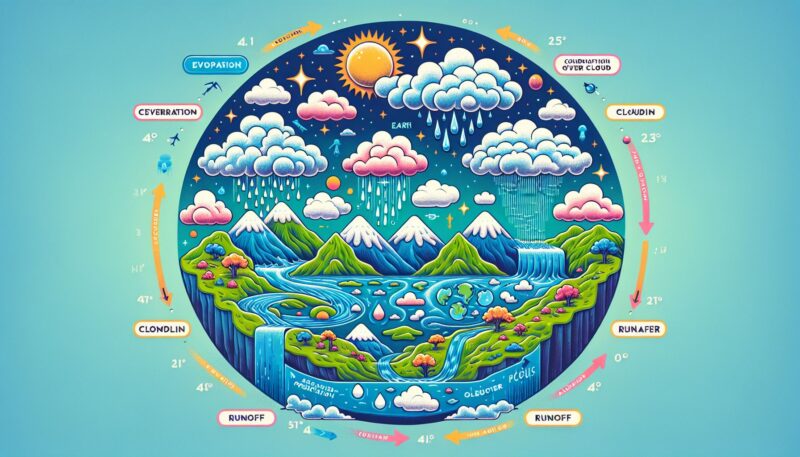
Water is the lifeblood of our planet, coursing through various channels and forms, majestically completing a cycle that is as ancient as the Earth itself. The hydrologic cycle, also known as the water cycle, is a continuous process by which water is circulated throughout the Earth’s atmosphere, land, and oceans. This remarkable cycle is essential for sustaining life, shaping weather patterns, and sculpting the geological features of the Earth.
The Magic of the Hydrologic Cycle
The hydrologic cycle is the natural sequence of events that water undergoes as it moves from the Earth’s surface to the atmosphere and back again. This cycle can be seen as a global system of water transfer, which is powered by the energy from the sun and the force of gravity.
The Solar Powered Engine: Evaporation
The journey begins with evaporation, the process by which water is converted from liquid to vapor. Bodies of water, such as oceans, rivers, and lakes, provide the primary sources of evaporation. Approximately 85% of the global evaporation occurs over the oceans, contributing to the vast majority of water vapor in the Earth’s atmosphere (US Geological Survey).
The Unsung Heroes: Transpiration and Plant Contributors
Closely allied with evaporation is transpiration – the silent and often overlooked process by which water is released from plants to the atmosphere. If you combine the amount of water evaporated from the Earth’s surface with the amount transpired by plants, you get a term called “evapotranspiration,” a significant contributor to the hydrologic cycle.
The Transformation: Condensation
As water vapor rises and cools in the atmosphere, it transforms back into liquid form through condensation. This process is responsible for creating clouds, which contain millions of tiny water droplets or ice crystals, depending on the temperature of the atmosphere.
The Descent: Precipitation
When these droplets combine to become heavier than the surrounding air, they fall to the Earth as precipitation. Rain, snow, sleet, and hail are all forms of precipitation that play a key role in returning water to the surface of the Earth (National Weather Service).
The Earth’s Embrace: Infiltration and Percolation
Once precipitation reaches the ground, it embarks on different pathways. Some of the water seeps into the soil through a process called infiltration. This water can then move deeper through the soil via percolation, eventually replenishing the underground water repositories known as aquifers.
The Underworld Journey: Groundwater and Aquifers
Groundwater is an integral component of the hydrologic cycle, constituting a significant portion of the Earth’s freshwater reserves. It moves through aquifers, which are porous rocks that can hold and transmit water. Groundwater movement is generally slow and can take thousands of years to cycle through the environment.
The Return Flow: Baseflow and Discharge
Groundwater can also contribute to surface water bodies through a process called baseflow, which is the sustained flow of a river in the absence of direct runoff. This baseflow is essential for maintaining river ecosystems, especially during dry periods. Rivers and streams eventually lead the water back to larger bodies like oceans, where the cycle begins anew. This release of groundwater into waterways is termed as discharge.
The Overland Path: Runoff and Surface Water Channels
Not all water immediately seeps into the ground; some of it travels over the land as runoff. This can happen because the soil is saturated, frozen, or impervious. Runoff contributes to the flow in rivers and streams, known as streamflow, which includes both baseflow and runoff.
The Geographical Plumbing: Watersheds and Drainage Basins
The land area that catches precipitation and contributes runoff to a common outlet, such as a river, lake, or bay, is known as a watershed or drainage basin. These natural hydrological entities play a crucial role in gathering the water within their defined borders and channeling it into larger water bodies.
The Storage Units: Lakes, Reservoirs, and Wetlands
Lakes and reservoirs function as natural and artificial storage areas for freshwater. Wetlands act like sponges, absorbing and releasing water while filtering pollutants and providing habitat for countless species.
The Transitional Waters: Estuaries and the Interaction with Oceans
Estuaries, where freshwater from rivers meets and mixes with saltwater from the ocean, are important nurseries for many marine species and serve as buffers against coastal erosion. The oceans, covering about 70% of the Earth’s surface, receive the outflow from these freshwater sources and complete the global hydrologic cycle.
The Frozen Time Capsules: Glaciers, Icebergs, and Permafrost
In the polar regions and atop some high-altitude areas, glaciers and icebergs represent stored freshwater, which plays a slower part in the hydrologic cycle. Permafrost and the seasonal snowpack also store large amounts of freshwater, which is gradually released as they melt.
The Quality of Life: Water Quality and Pollutants
The health of the hydrologic cycle is closely linked to water quality. Natural processes and human activities can both contribute to the concentration of substances such as heavy metals, nutrients, pathogens, and microplastics in the water system, leading to water pollution.
Nature’s Alarm: Eutrophication and Algal Blooms
An overabundance of nutrients, particularly nitrogen and phosphorus, can lead to eutrophication, where water bodies experience increased growth of algae and aquatic plants. This, in turn, can cause algal blooms, which deplete the oxygen in the water, causing harm to aquatic life.
The Invisible Parameters: pH, Salinity, Hardness, and More
Water quality is also defined by parameters such as pH, salinity, hardness, and alkalinity. The balance of these factors is crucial for the health of ecosystems and the suitability of water for human use.
Innovative Solutions: Water Treatment and Management
To ensure that water remains clean and safe for consumption, a series of water treatment processes, such as filtration, disinfection, chlorination, ozonation, UV irradiation, coagulation, flocculation, sedimentation, adsorption, and ion exchange are utilized.
Desalination and the Quest for More Freshwater
Given the scarcity of freshwater in many parts of the world, desalination (removing salt from seawater) through methods like reverse osmosis has become increasingly important.
The Infrastructure of Life: Water Distribution Systems
To deliver this treated water, intricate systems, including water towers, **p