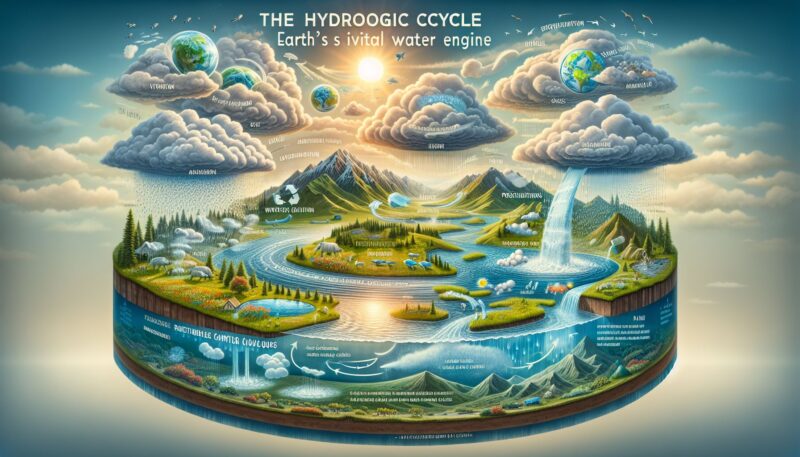
Water is Earth’s lifeblood, fueling ecosystems, cultures, and economies. It’s in constant motion, cycling from the ocean to the atmosphere to the land and back again. This natural process is known as the hydrologic cycle, a complex system responsible for the distribution and movement of water around the globe. In this article, we’ll delve into the intricacies of the hydrologic cycle, exploring its phases and how it sustains life on our planet.
What Is the Hydrologic Cycle?
The hydrologic cycle, also referred to as the water cycle, is the continuous movement of water on, above, and below the surface of the Earth. It’s a closed system – meaning no water enters from beyond Earth nor leaves into space – and it consists of various processes: evaporation, transpiration, condensation, precipitation, infiltration, percolation, runoff, and storage. Each stage of the hydrologic cycle plays a crucial role in maintaining the balance of water on Earth.
The Stages of the Hydrologic Cycle
- Evaporation: The sun’s heat causes water from oceans, lakes, rivers, and wetlands to transform from liquid to vapor, ascending into the atmosphere.
- Transpiration: Plants also contribute to this vapor through transpiration, where water absorbed by roots is released into the air from leaves.
- Condensation: As water vapor rises and cools, it changes back into liquid form, creating clouds.
- Precipitation: Water falls back to the Earth as rain, snow, sleet, or hail.
- Infiltration: Some of the water that reaches the ground seeps into the soil.
- Percolation: Water moves downward within the soil, replenishing aquifers – the underground layers of water-bearing permeable rock.
- Runoff: Water that doesn’t infiltrate the ground flows over the surface, collecting in rivers, lakes, and oceans.
- Storage: Water is stored in various forms – as ice in glaciers, as groundwater in aquifers, and as fresh surface water in lakes and rivers.
Importance of the Hydrologic Cycle
The hydrologic cycle is essential for providing fresh water to sustain human life, flora, and fauna. It governs how water is purified, distributed, and how ecosystems function. For instance, precipitation is vital for freshwater supply, while evaporation helps regulate our climate by removing excess heat from the surface.
Human Impact on the Hydrologic Cycle
Human activities, such as urban development, deforestation, and greenhouse gas emissions, are significantly impacting the hydrologic cycle. Climate change is altering precipitation patterns, increasing the frequency of extreme weather events, like droughts and floods. Pollution from industrial and agricultural sources can contaminate water supplies, affecting the health of ecosystems and the quality of water for human use.
Water Quality and Treatment
Maintaining the quality of water throughout the hydrologic cycle is crucial. Various pollutants can affect the health of water bodies:
- Nutrients: Excessive nutrients can lead to eutrophication, causing dense algal blooms that deplete oxygen levels.
- Pathogens: Bacteria and viruses from sewage and agricultural runoff pose risks to human health.
- Heavy metals: Industrial waste can introduce toxic metals into water systems.
- Microplastics: These tiny plastic fragments are becoming ubiquitous pollutants in aquatic environments.
Water treatment is essential for ensuring safe drinking water. Processes like coagulation, flocculation, and sedimentation remove particulates, while filtration and disinfection with chlorine or UV light help eliminate pathogens. Advanced techniques like reverse osmosis are effective in desalination, turning seawater into potable water.
Conservation and Management
Water conservation is also a critical element of managing the hydrologic cycle. Techniques such as rainwater harvesting capture precipitation for use in irrigation and other applications. Greywater reuse involves recycling wastewater from sources like sinks and showers for non-potable uses, reducing the demand on freshwater sources.
Effective management includes understanding watershed or catchment areas – the land areas that drain into a common waterway. Protecting these areas can improve water quality and sustainability.
Challenges and Opportunities
Water scarcity affects over two billion people globally, and water stress – when demand exceeds supply – is only expected to increase due to population growth and climate change. Addressing these challenges requires integrated water resources management, which includes both the physical components of the hydrologic cycle and the needs of all water users.
Water diplomacy can help resolve conflicts over water resources, which are becoming more common as scarcity increases. By fostering cooperation and fair sharing of water, communities and nations can work towards sustainable water solutions.
Conclusion
The hydrologic cycle is fundamental to life on Earth, but it is under increasing pressure from human activities. Understanding and preserving this cycle is vital for ensuring a future where people and nature can thrive together. It requires a combination of sound science, innovative technology, and thoughtful policy, all aimed at sustainable water use.
Sources:
-
“Water in the Balance” by the International Water Management Institute. This source offers insights into the hydrologic cycle’s integral role in global water balance and the importance of sustainable management.
IWMI -
“Water Cycle” by the United States Geological Survey. This comprehensive resource explores the water cycle in detail, providing scientific explanations for each process within the hydrologic cycle.
USGS